
Wine · Myths & evidence · Reference page
Did Dom Pérignon invent Champagne?
No. Dom Pérignon made better still wine and, like the French makers of his day, treated bubbles as a fault. Sparkling wine was described in London in 1662, and Champagne's method was built over two centuries. The legend of the monk who drank the stars was promoted by the Champagne trade in 1889.
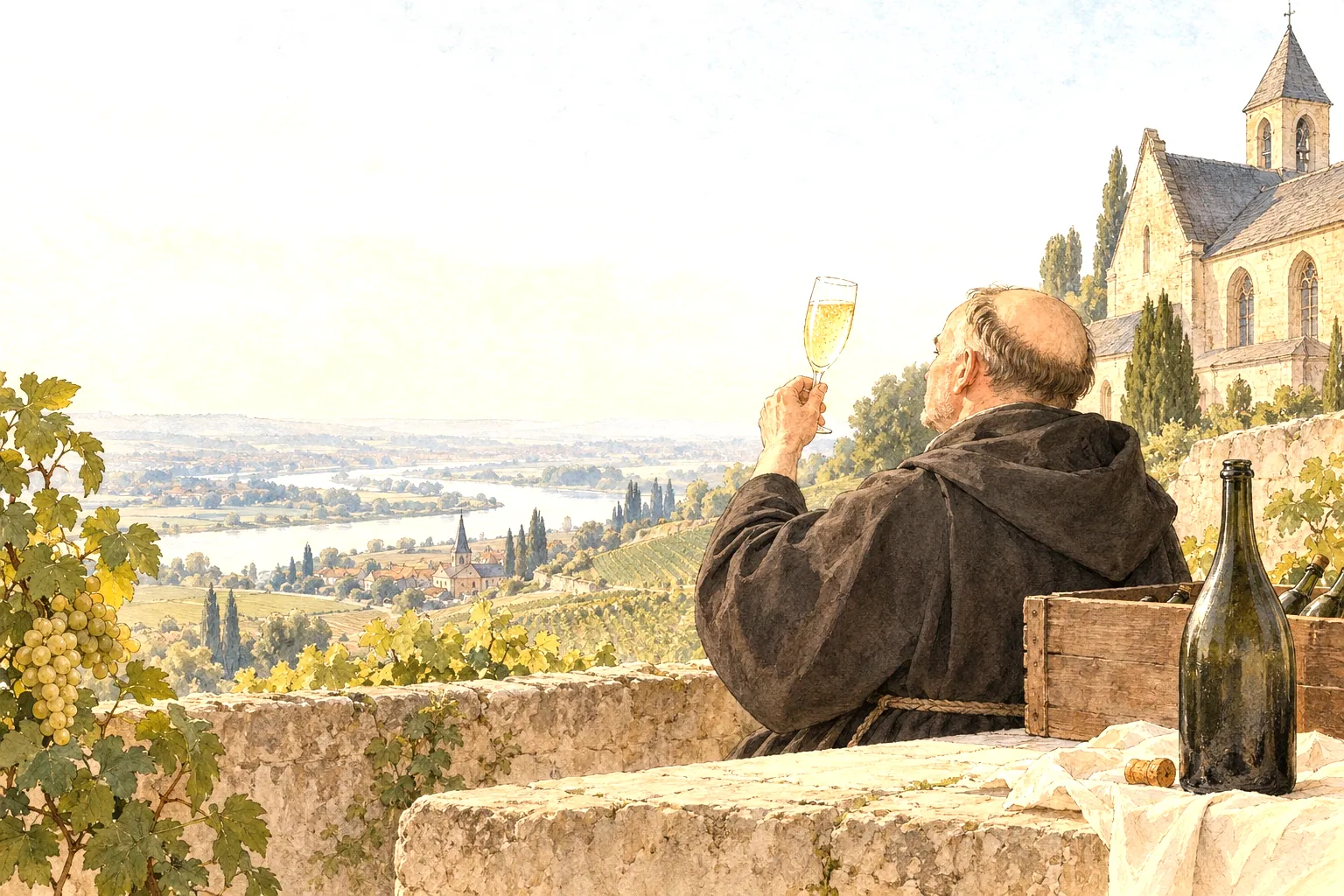
The legend
The story is familiar: a Benedictine monk at the abbey of Hautvillers tastes a wine that has started to fizz in the bottle and calls out to his brothers that he is drinking stars. He becomes the inventor of Champagne.
The historian Garritt Van Dyk traces the popular form of this story to the 1889 Universal Exhibition in Paris, the one that opened the Eiffel Tower. A pamphlet of the Syndicat du Commerce des Vins de Champagne, the merchants' association, presented Pérignon as the "inventor" of sparkling Champagne. It drew on an earlier letter from Dom Grossard, a monk of Hautvillers, to the mayor of Aÿ, which credited Pérignon with perfecting white wine from black grapes, with pioneering effervescence and with championing bottles and corks. Of these claims, Van Dyk writes, only the first holds. The famous line about stars is, in Van Dyk's words, only "often attributed" to him.
What Dom Pérignon actually did
Pierre Pérignon became procurator of the Benedictine abbey of Hautvillers in 1668. The Comité Champagne, the region's own trade body, credits him and Frère Oudart of the abbey of Pierry with blending wines from different plots and villages in a far more deliberate way, giving more balanced wines. In the second half of the seventeenth century Champagne also adopted a gentler press, with the juice drawn off in fractions, which made it possible to make white wine from black grapes such as Pinot Noir.
Champagne's wine already had a great name as a still wine. Since the baptism of Clovis at Reims in 496, almost every French king was crowned in Reims cathedral, and the region's wine, served at the coronation banquets, became known as the wine of kings.
None of this was about bubbles. Until late in the seventeenth century, the Comité notes, whether a Champagne wine had bubbles depended on outside conditions. To French makers and drinkers of the time, a wine that fizzed was faulty. Van Dyk's summary is that Pérignon was trying to get rid of the bubbles, not to put them in.
A paper read in London, 1662
On 17 December 1662, six years before Pérignon took charge at Hautvillers, the physician Christopher Merret (also spelled Merrett), one of the founders of the Royal Society, read a paper to the Society in London: Some Observations concerning the Ordering of Wines. The manuscript survives in the Society's archive. Most of it is practical advice on keeping, fining and correcting wine. One passage records that "Our Wine-coopers of latter times use vast quantities of Sugar and Melosses" to all sorts of wines "to make them drink brisk and sparkling". That is a description of adding sugar to provoke a second fermentation, the principle behind sparkling wine.
England also had the tools. A 1615 ban on burning wood in industrial furnaces pushed English glassmakers to coal, which gave stronger glass, and corks were already used for bottled cider and perry. Merret documented a practice; he did not invent Champagne either. The point is that the bubbles were understood, and wanted, in London before they were wanted in Champagne.
How Champagne learned to sparkle
In Champagne the change came between about 1670 and 1720, when making sparkling wine became a deliberate choice rather than an accident of the weather. In the 1690s "Champagne wines" began to be named as such. Cork stoppers were introduced in the region in 1685, and a new, much thicker Champagne bottle followed in 1770. Gas that escaped from casks could now be kept in the bottle.
Control came later still. For a long time the result depended on when the wine was bottled, and bottles often burst or went flat. At the end of the eighteenth century producers began adding sugar to bottled wine. Around 1800 riddling racks, the pupitres, were developed to move the yeast deposit into the neck so it could be removed by disgorging. In 1837 Jean-Baptiste François, a pharmacist in Châlons, worked out how to measure the right dose of sugar, and far fewer bottles broke. The wire cage and its metal cap followed. Only in 1860 did Pasteur show that yeast turns sugar into alcohol and carbon dioxide, and in 1884 Armand Walfard introduced disgorging by freezing the neck in a bath at about −27 °C. The first Champagne houses, among them Ruinart, Moët, Veuve Clicquot and Heidsieck, emerged in the eighteenth century.
UNESCO's World Heritage listing of the Champagne hillsides, houses and cellars in 2015 calls this the benchmark method of sparkling wine, based on a second fermentation in the bottle, and notes that it drew on British and German technical and commercial contributions. The listing traces the system's roots to Hautvillers and the hillsides around Aÿ, from where it spread in the eighteenth and nineteenth centuries to Reims and Épernay. Second fermentation in the bottle needs a vast network of cellars; in Reims the houses found it in old Gallo-Roman and medieval chalk quarries. The listing gives a special place to women, and to the Franco-German heirs of the old Champagne fairs, among those who built it. Champagne is the work of many people over two centuries. A single monk with a moment of inspiration is a better story, which is why the trade told it.
How it connects
Wine region
- origin Champagne
Grape variety
- related Pinot Noir
- related Chardonnay
Continue exploring
- CountryFrance162 entries in the atlas so far
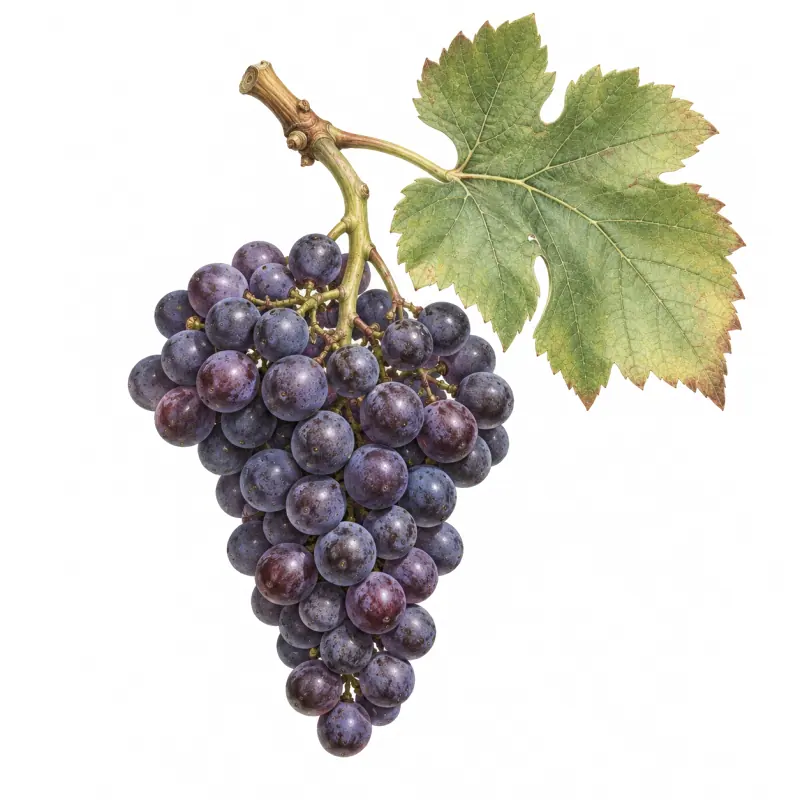 Grape varietyPinot Noir
 RecipeBaeckeoffeAlsace, France
 RecipeBœuf bourguignonDijon, France
 RecipeCoq au vinBurgundy, France
 Grape varietyChardonnay
- Wine regionChampagneReims, France
 RecipeEscargots à la bourguignonneBurgundy, France
 RecipeFondue au ComtéJura massif, Franche-Comté, France
 RecipeGougèresBurgundy, France