
Meat · Recipe · Burgundy · Reference page
Bœuf bourguignon
Beef braised slowly in red Burgundy with bacon, onions and mushrooms until the meat yields to a spoon and the wine has become a glossy sauce. A farmhouse dish of Burgundy that became a pillar of French bourgeois cooking.
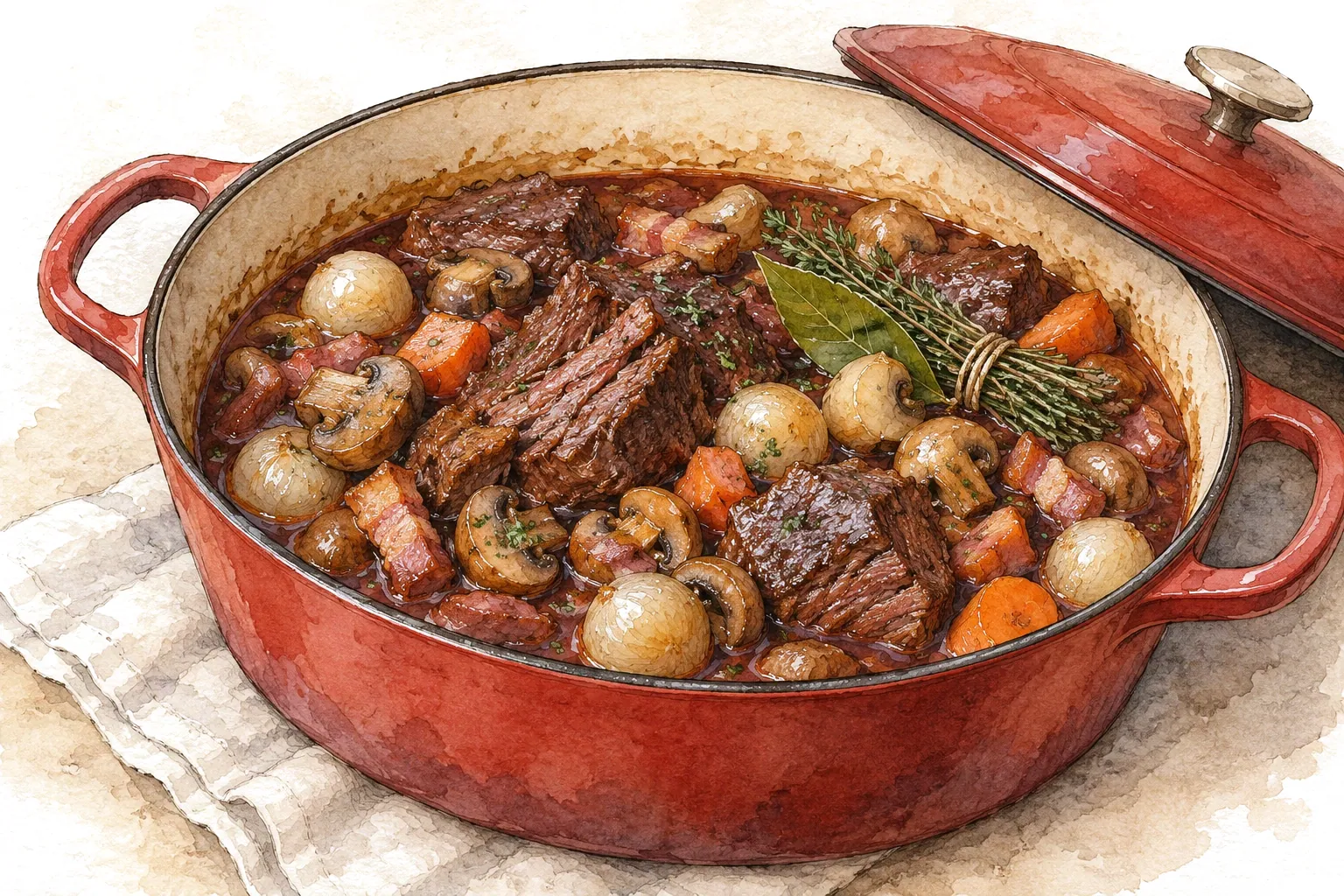
- Servings
- 6
- Preparation
- 45 min
- Cooking
- 3 h 30
- Total
- 4 h 15
- Difficulty
- Moderate
Equipment
- Large cast-iron casserole with a lid (5–6 litres)
- Frying pan for the garnish
- Slotted spoon; kitchen string for the bouquet garni
Ingredients
The braise
The garnish
Method
Pat the beef dry with kitchen paper and season lightly with salt. If you have time, you may first marinate it overnight in the wine with the carrot, onion and bouquet garni (a common practice in classic recipes); drain and dry it very well before browning, keeping the wine.
Why Wet meat steams instead of browning. Browning (the Maillard reaction) creates the deep, roasted flavours that the long braise will carry into the sauce.
Heat the oil in the casserole and brown the lardons until golden. Lift them out. In the fat, brown the beef in batches over a high heat, without crowding, until well coloured on all sides. Set aside with the lardons.
Why Crowding the pan lowers its temperature and releases juices; the meat then boils grey.
Lower the heat, add the butter, carrots and onion and cook for 5–8 minutes until softened. Add the garlic for the last minute.
Timer · 6 min6:00Return the beef and lardons. Sprinkle over the flour and stir for 2–3 minutes so it coats the meat and toasts lightly (the French call this *singer*).
Why Toasting the flour in fat removes its raw taste; later it thickens the wine evenly instead of forming lumps.
Timer · 3 min3:00Pour in the wine, scraping up the browned bits from the bottom. Bring to the boil and let it bubble for 2 minutes, then add the stock and the bouquet garni. The liquid should come almost to the top of the meat.
Timer · 2 min2:00Cover and braise in an oven at 150 °C (or on the lowest possible heat on the hob) for 2 to 3 hours, depending on the cut and the size of the pieces, until a piece of beef breaks apart easily with a spoon. Check occasionally; the liquid should tremble, not boil.
Why Collagen in the shoulder dissolves into gelatine over a wide range of temperatures, very slowly when the meat is merely warm and faster the hotter it gets. At a bare simmer for hours, with the inside of the meat well above 70 °C, it slowly turns to gelatine, making the beef tender and the sauce silky. A hard boil tightens the muscle fibres and dries them out.
Timer · 2 h 30150:00Meanwhile, make the garnish. Put the small onions in a frying pan with half the butter, the sugar and water to half their height; cook until the water evaporates and they glaze golden. Brown the mushrooms in the remaining butter over a high heat.
Timer · 15 min15:00When the beef is tender, remove the bouquet garni. If the sauce is thin, lift out the meat and reduce the liquid until it coats a spoon (*nappe*). Return the beef, add the onions and mushrooms, simmer for 10 minutes, taste and adjust seasoning. Scatter with parsley.
Timer · 10 min10:00
To drink & serve with
- Pinot Noir
A red Burgundy — the same style as the cooking wine, or a step up. Its acidity cuts the richness of the gelatinous sauce, and its gentle tannins sit easily with braised beef and mushrooms.
- Côte de Nuits
For an occasion: a village wine from the Côte de Nuits, such as Gevrey-Chambertin or Nuits-Saint-Georges.
- Charlotte
Serve with steamed or boiled waxy potatoes, a buttery mash, or fresh egg tagliatelle.
- Tagliatelle
Fresh tagliatelle catch the sauce in their folds.
Substitutions
- Red Burgundy → Any dry, fresh, not-too-tannic red. Heavily oaked or very tannic wines can turn bitter on reduction.
- Lardons → Omit and brown the beef in oil and butter; add a little more salt at the end.
- Plain flour (for a gluten-free dish) → Skip the singer; thicken the finished sauce with a little cornflour slaked in cold water, or simply reduce it.
Common mistakes
- Using lean, quick-cooking cuts such as fillet or rump: they dry out instead of becoming tender.
- Boiling the stew hard: the meat turns stringy even though it is cooked for hours.
- Adding the mushrooms and onions at the start: they collapse. They are cooked separately and added at the end.
Storage & reheating
Like most braises it is better the next day. Cool quickly, refrigerate covered within 2 hours and eat within 2 days (UK FSA; US USDA allows 3–4 days). Reheat only once, until steaming hot throughout; the sauce should come to the boil. It keeps best for up to 3 months frozen (safe for longer; the mushrooms soften a little).
Safety
Braised beef is safe once it is cooked through; food-safety agencies set minimum temperatures for whole cuts (e.g. 63 °C with a rest in US guidance) that a long braise far exceeds. The main risk is afterwards: cool leftovers within two hours and reheat them only once, until steaming hot. Allergens: gluten (flour), milk (butter) and sulphites (wine); celery only if the stock contains it.
Allergens
Gluten · Milk · Sulphites
Check labels: stock, bacon and sauces can contain further allergens.
From farmhouse to the canon
Braising a tough cut slowly in the local wine is common sense in a wine region where draught oxen and old cattle were once eaten, and versions of beef in red wine were cooked in Burgundy long before anyone wrote them down as bœuf bourguignon. The dish was in the printed professional repertoire by the early twentieth century: Auguste Escoffier's Guide culinaire (1903) codified the garnish à la bourguignonne (glazed small onions, sautéed mushrooms and lardons) and applied it to a whole larded joint marinated in cognac and braised in red wine, the pièce de bœuf à la bourguignonne, rather than to a stew of cubes. In the English-speaking world it became famous through mid-twentieth-century French cookery books and television; the first episode of Julia Child's The French Chef (1963) featured it.
There is no single correct recipe. Some cooks marinate overnight, others never; some add a spoonful of tomato paste or a square of dark chocolate, which purists reject; some finish with a splash of marc de Bourgogne. Cuts vary too: paleron, macreuse, joue, and gîte are all used, often mixed for texture.
How it connects
Wine region
- origin Burgundy
- pairs with Côte de Nuits
Grape variety
- pairs with Pinot Noir
Cut
- made with Paleron (shoulder blade)
- made with Joue (cheek)
- made with Macreuse (shoulder clod)
- used in Gros bout de poitrine (brisket point)
- used in Filet mignon (French butchery)
Breed
- made with Charolais
Pasta shape
- pairs with Tagliatelle
Potato
- pairs with Charlotte
Recipe
- similar Coq au vin
- related Œufs en meurette
Place
- related Bœuf bourguignon In preparation
Continue exploring
- CountryFrance162 entries in the atlas so far
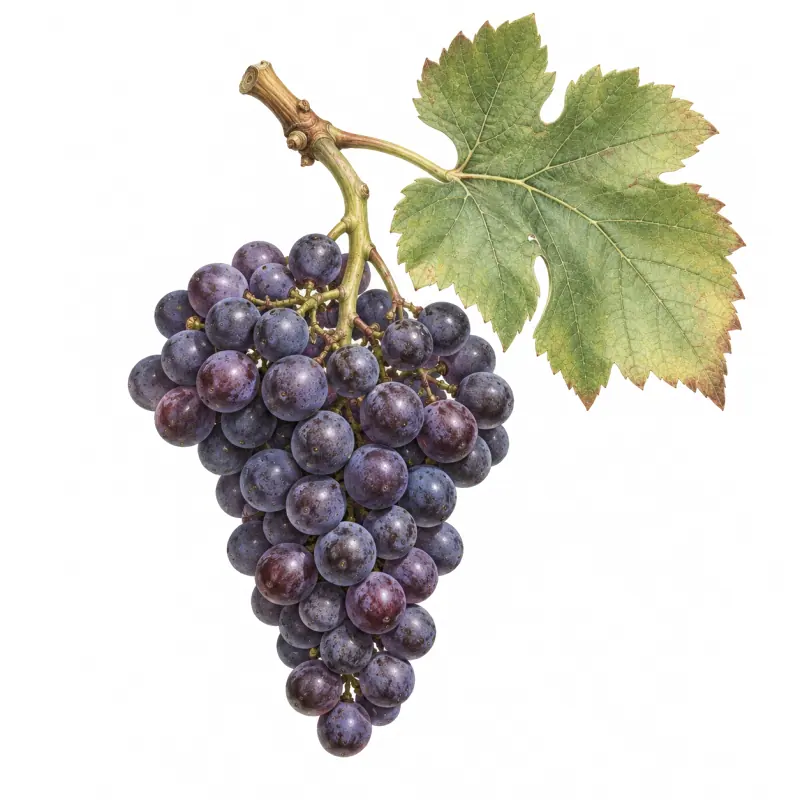 Grape varietyPinot Noir
- Wine regionBurgundyBeaune, France
- Wine regionCôte de NuitsNuits-Saint-Georges, France
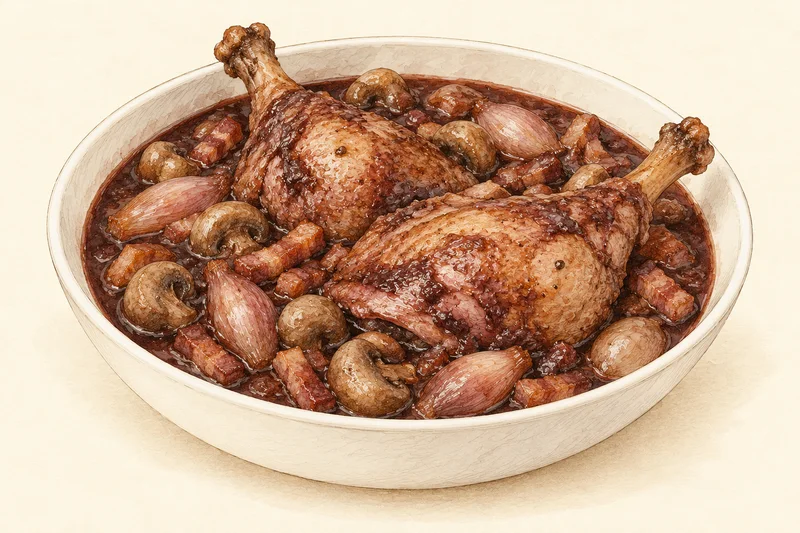 RecipeCoq au vinBurgundy, France
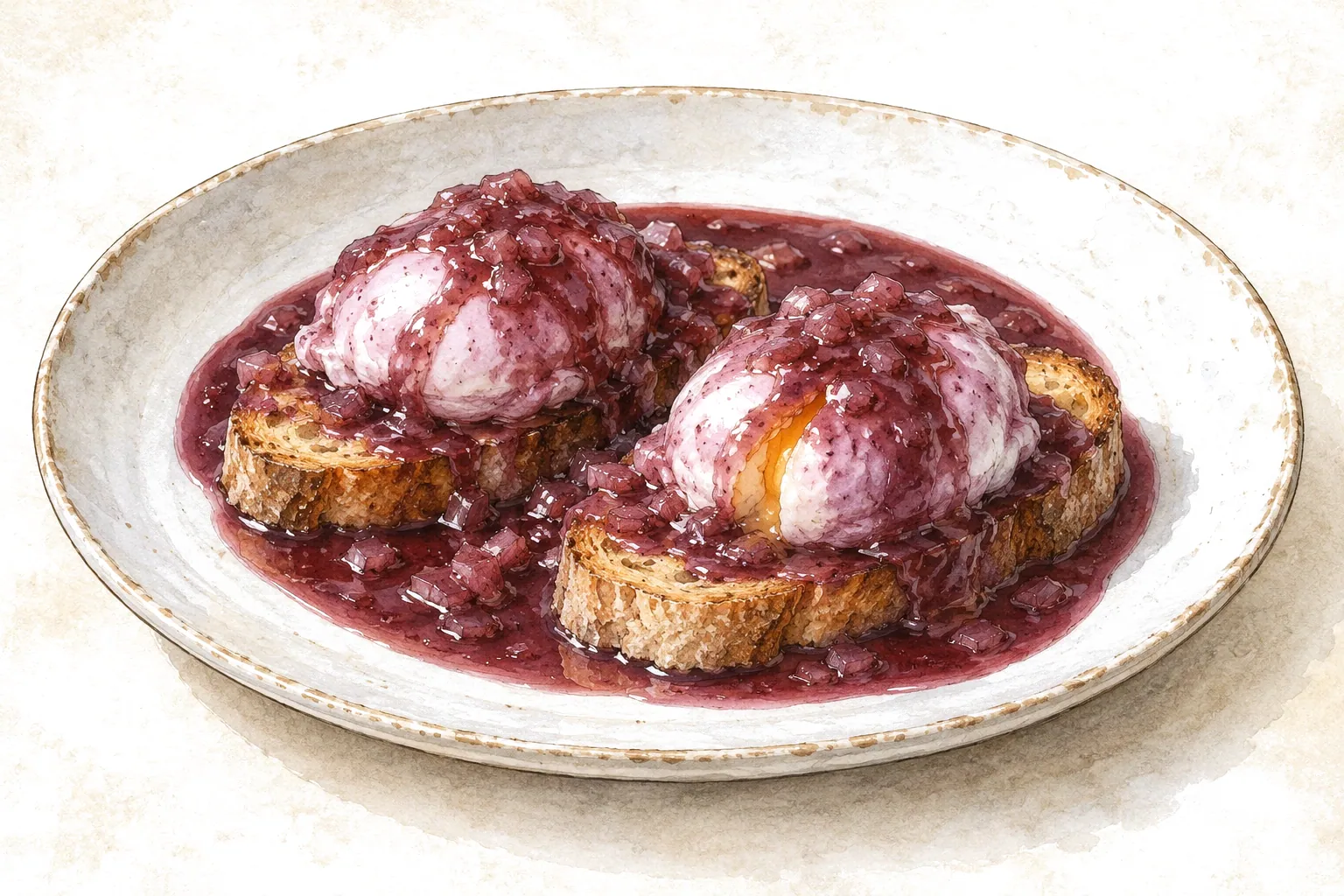 RecipeŒufs en meuretteBurgundy, France
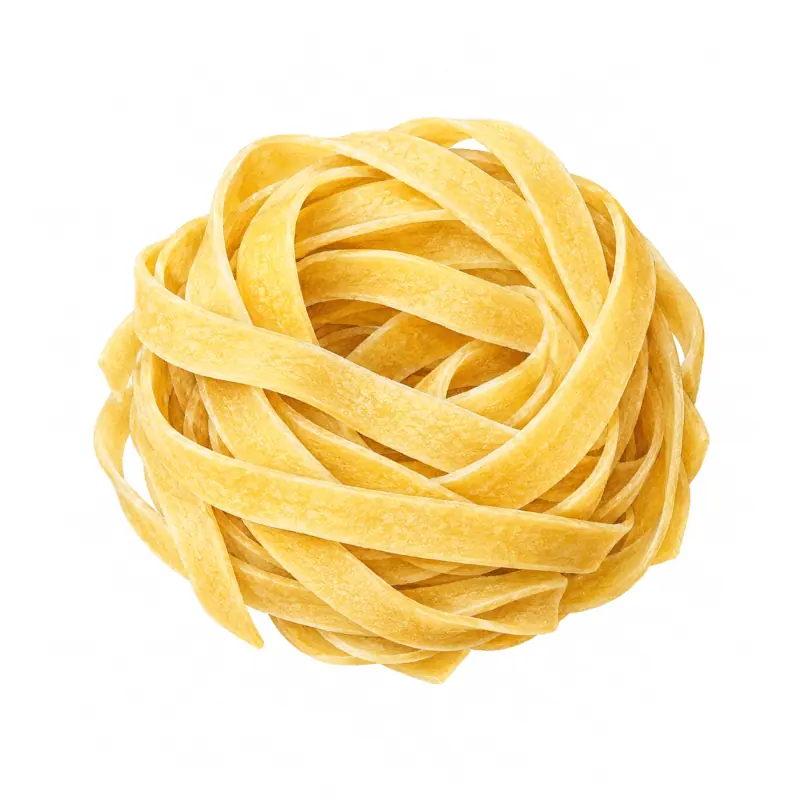 Pasta shapeTagliatelle
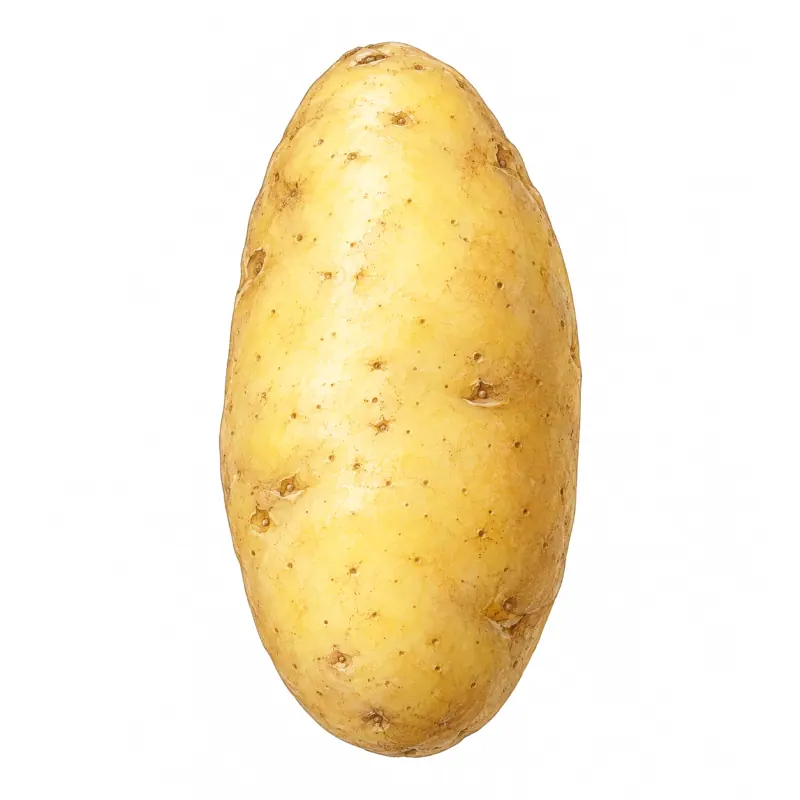 PotatoCharlotte
- CutPaleron (shoulder blade)
 RecipeJanssons frestelseSweden