
Explore the world · Recipe · Franche-Comté · Reference page
Fondue au Comté
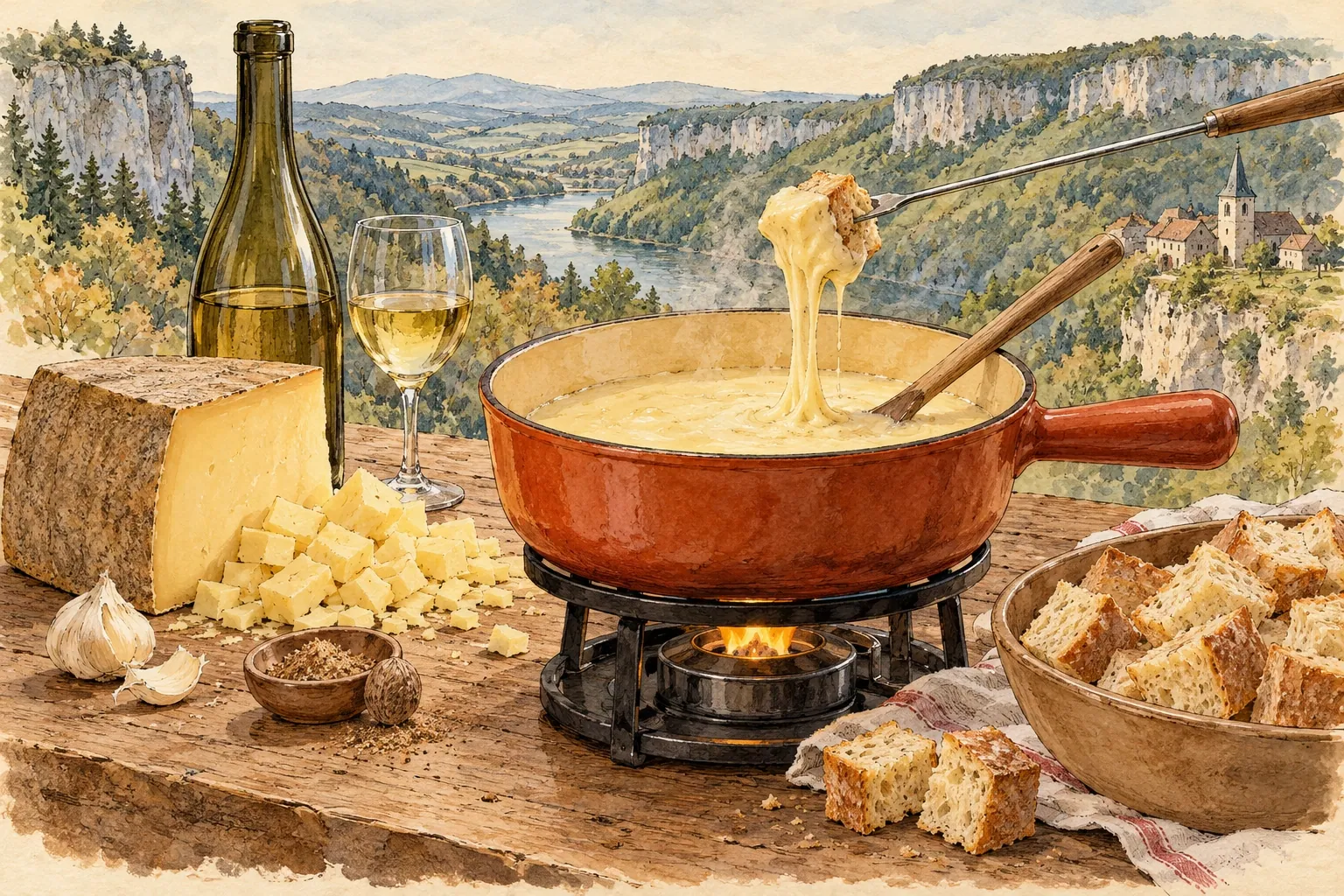
Comté cheese melted in Côtes du Jura white wine with garlic and nutmeg, stirred smooth and eaten with cubes of stale bread. The Comté interprofession's recipe uses 1 kg of Comté aged at least ten months and a bottle of Jura white for four.
- Servings
- 4
- Preparation
- 15 min
- Cooking
- 15 min
- Total
- 30 min
- Difficulty
- Easy
Equipment
- Fondue pot (caquelon) and table burner
- Wooden spoon
- Long fondue forks
Ingredients
Method
Rub the inside of the fondue pot with the crushed garlic. Cut the Comté into small cubes or grate it, and put it in the pot.
Set the pot over a moderate heat and pour in 2–3 glasses of the wine at once. Stir constantly with the wooden spoon until the cheese has completely melted.
Why Constant stirring over moderate heat lets the cheese melt into the wine evenly. Too hot, and the proteins clump and the fat separates.
Timer · 10 min10:00Judge the texture: if it is too thick, add more wine a little at a time. Season with nutmeg. Keep stirring until the fondue looks like a smooth, even cream.
Why The CIGC asks you to keep stirring 'to bind it': movement holds fat, water and protein together.
Light the burner on the table, set the pot on it and keep stirring. Each guest spears a cube of bread on a fork, through the soft crumb into the crust, and turns it in the fondue to coat it.
To drink & serve with
- Jura
The CIGC's sommelier advises serving only Jura wine, ideally the same wine used in the pot.
- Chardonnay
A Côtes du Jura or L'Étoile white from Chardonnay, or a Savagnin.
Substitutions
- Côtes du Jura blanc → Another dry, crisp white with good acidity, such as a Savoie or Swiss white.
- Comté of at least 10 months → A blend of a younger and an older Comté: the young one melts well, the old one gives flavour.
Common mistakes
- Heating too fast or letting it boil: the cheese turns stringy and the fat separates.
- Adding all the wine at once: the fondue may be too thin. Start with 2–3 glasses.
- Fresh bread: it soaks up the cheese and falls off the fork. Use bread a day or two old.
Storage & reheating
Eat at once. Leftover cheese can be refrigerated and used in a gratin within 2 days.
Safety
Keep the burner low and stable and never leave it unattended. The wine's alcohol does not all evaporate: offer an alcohol-free alternative to children and to anyone avoiding alcohol. Allergens: milk, gluten (bread), sulphites (wine).
Allergens
Milk · Gluten · Sulphites
Check labels: stock, bacon and sauces can contain further allergens.
Dietary
vegetarian
The interprofession's fondue
Comté is a hard cheese with a pressed, cooked curd, made in the Jura massif and ripened for months in cellars. Its interprofession, the Comité Interprofessionnel de Gestion du Comté (CIGC), publishes a winter recipe booklet that opens with this fondue. It is a plain version: 1 kg of Comté of at least ten months' ripening for four people, a bottle of Côtes du Jura white (or part white, part Vin Jaune for a fondue royale), a clove of garlic, nutmeg and stale bread.
It contains no kirsch and no starch. The CIGC's sommelier adds one rule: serve it only with Jura wine, ideally the wine that went into the pot.
Keeping it smooth
A cheese fondue is an emulsion of melted fat and protein in wine. The acidity of a crisp white wine helps the cheese proteins disperse instead of forming rubbery strings, and gentle, constant stirring keeps the fat suspended. The CIGC's method follows that logic: wine goes in as soon as the cheese is heating, a few glasses first, the rest only if the fondue is too thick, with stirring throughout until it looks like a smooth cream.
Aged Comté has more flavour but less moisture than a young one, so the amount of wine is given as a range. At the table the burner only needs to keep the fondue warm.
How it connects
Place
- origin Franche-Comté In preparation
Wine region
- pairs with Jura
Grape variety
- pairs with Chardonnay
Recipe
- related Gougères
Continue exploring
- CountryFrance162 entries in the atlas so far
 RecipeGougèresBurgundy, France
 Grape varietyChardonnay
- Wine regionJuraLons-le-Saunier, France
 StoryDid Dom Pérignon invent Champagne?Hautvillers, France
 StoryThe Judgment of Paris, 1976Paris, France
 Grape varietyPinot Noir
- Wine regionAlto AdigeBolzano, Italy
- Wine regionBurgundyBeaune, France
- Wine regionFranciacortaErbusco, Italy