
Meat · Recipe · Milan · Reference page
Ossobuco alla milanese
ossobuco alla milanese / os büs
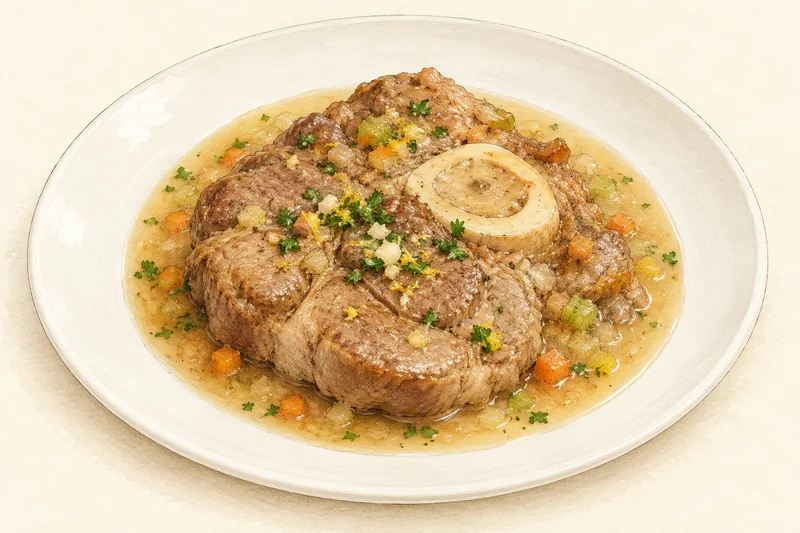
Thick slices of veal shank, bone and marrow included, floured, browned in butter and braised slowly with a soffritto, white wine and stock. It is finished with gremolada, a mince of parsley, garlic and lemon zest. The Milanese version is cooked without tomato and served with saffron risotto.
- Servings
- 4
- Preparation
- 30 min
- Cooking
- 2 h
- Total
- 2 h 30
- Difficulty
- Moderate
Equipment
- Wide heavy pan with a lid that holds the four shanks in one layer
- Wide spatula for turning; zester or fine grater
Ingredients
The braise
The gremolada
Method
Pat the shanks dry. Make 2 or 3 small cuts in the membrane round the edge of each slice, then dust with flour and shake off the excess.
Why The outer membrane shrinks as it cooks; nicking it keeps the slices flat. The flour is a veil, not a coating: it helps browning and gives body to the sauce.
Heat the butter and oil in the pan over a medium-high heat and brown the shanks well, 3–4 minutes a side. Lift them out.
Timer · 8 min8:00Lower the heat, add the onion, carrot and celery and soften them for 5–7 minutes, stirring, without letting them burn.
Timer · 6 min6:00Return the shanks, pour in the wine and let the alcohol evaporate. Season with salt and pepper.
Add a ladle of hot stock, cover and simmer on a low heat for 1½ to 2 hours, depending on thickness. Turn the shanks once or twice with a wide spatula and add stock whenever the pan looks dry.
Why Hot stock keeps the simmer steady; cold liquid stops the cooking and tightens the meat. Turning gently keeps the marrow in the bone.
Timer · 1 h 45105:00The meat is ready when it almost comes away with a fork and the sauce is thick and glossy. Mix the parsley, garlic and lemon zest and scatter the gremolada over the shanks just before serving, or stir it into the sauce for the last 2–3 minutes.
To drink & serve with
- Risotto alla milanese
The classic Milanese partner: saffron risotto. Polenta or a light mash also work.
- Valtellina
MilanoFree suggests Lombard reds: Nebbiolo (Chiavennasca) from Valtellina or Bonarda dell'Oltrepò Pavese.
Substitutions
- Butter and oil → Butter only, or clarified butter. Olive oil with or instead of butter is an accepted variant.
- Plain flour (gluten-free) → Skip the flour or use rice flour; reduce the sauce a little longer.
- In bianco → For the common home variant, add 1–2 tbsp tomato paste or 2–3 tbsp passata after the wine. Artusi's 1891 recipe used tomato.
Common mistakes
- Cooking on a high flame: ossobuco wants time, not heat.
- Adding cold stock: it stops the simmer.
- Making the gremolada too early: it loses its fresh smell.
Storage & reheating
Good the next day. Cool quickly, refrigerate within 2 hours and eat within 2 days. Reheat gently with a little stock until steaming hot, and make fresh gremolada.
Safety
Contains gluten (flour), milk (butter), celery and sulphites (wine). Marrow bones are hot: serve with a small spoon.
Allergens
Gluten · Milk · Celery · Sulphites
Check labels: stock, bacon and sauces can contain further allergens.
A Milanese dish, with or without tomato
Pellegrino Artusi, writing in Florence in 1891, said ossobuco was "a dish best left to the Milanese" and described it modestly: a hollow, meaty piece of bone from the leg or shoulder of a milk-fed calf, cooked on a battuto of onion, celery, carrot and butter, finished with water and tomato, then flavoured with chopped lemon peel and parsley.
Milan claims it more firmly today. The Comune di Milano gave ossobuco alla milanese a Denominazione Comunale (De.Co.) by a resolution of 14 December 2007. The codified method floured meat, butter and onion, then wine and stock added a little at a time, with the gremolada compulsory. The food magazine Scatti di Gusto lists the accepted variants as anchovy in the gremolada, olive oil with or instead of butter, and a very little tomato. MilanoFree says the most traditional school cooks it in bianco. We did not see the De.Co. text itself.
Bone, marrow and a slow simmer
The name means "bone with a hole", and the marrow in that hole is the prize. The slices are cut 3–4 cm thick from the hind shank, where there is more meat and less connective tissue than in the foreleg. Small cuts in the membrane keep them flat, a light dusting of flour browns them and thickens the sauce, and a low, covered simmer with hot stock added little by little melts the connective tissue without drying the meat.
How it connects
Place
- origin Milan In preparation
Recipe
- pairs with Risotto alla milanese
Wine region
- pairs with Valtellina
Grape variety
- pairs with Nebbiolo
Cut
- made with Shin (UK)
Continue exploring
- CountryItaly107 entries in the atlas so far
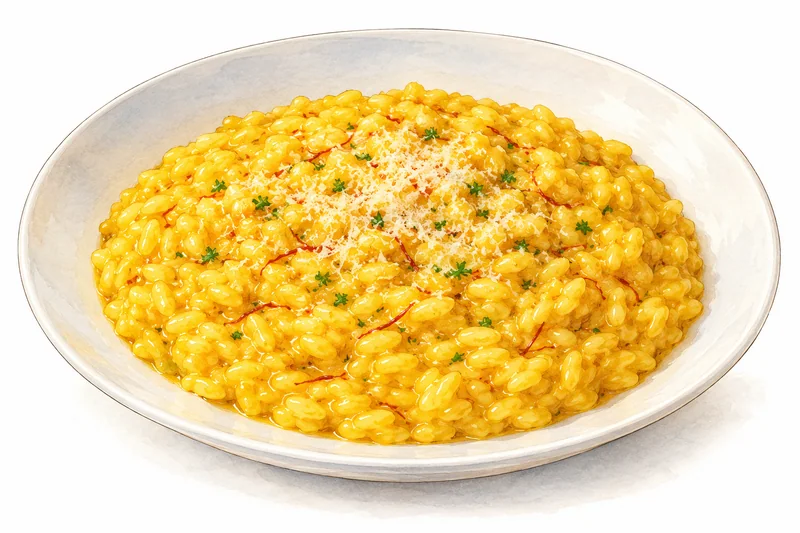 RecipeRisotto alla milaneseMilan, Italy
- Grape varietyNebbiolo
- Wine regionValtellinaSondrio, Italy
 RecipeRisi e bisiVenice, Italy
 RecipeRisotto ai funghi porciniVal di Sole, Trentino, Italy
- CutShin (UK)
- Wine regionBaroloBarolo, Italy
- Wine regionLombardyBrescia, Italy
- Wine regionPiedmontAlba, Italy