Explore the world · Recipe · France · Reference page
Baguette de tradition française
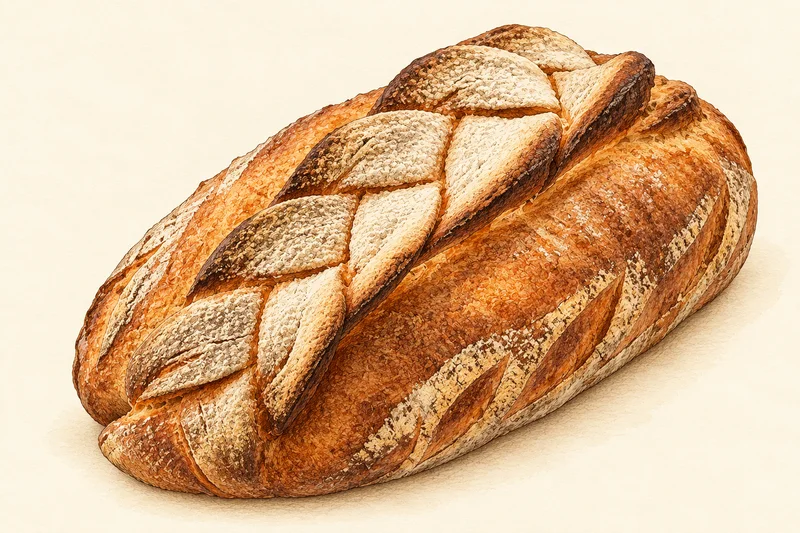
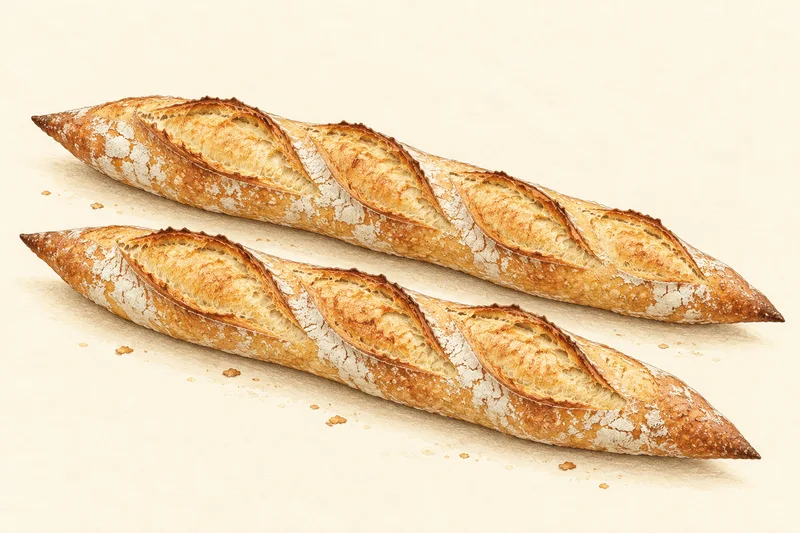
The French baguette made under the 1993 bread decree: only wheat flour, water, salt and yeast and/or levain, never frozen and without additives. This version makes three 300 g loaves with an autolyse, a little liquid levain and a long, cool rise.
- Servings
- 3
- Preparation
- 45 min
- Cooking
- 20 min
- Resting
- 4 h 40
- Total
- 5 h 45
- Difficulty
- Involved
Equipment
- Stand mixer with dough hook (or a large bowl for hand mixing)
- Linen couche or floured tea towel; baker's lame or razor blade
- Two baking trays, one preheated low in the oven for steam; wire rack
Ingredients
Dough
Baking
Method
Mix the flour and water for 4 minutes on slow speed. Cover with a damp cloth and leave for 1 hour.
Why This rest (autolyse) lets the flour hydrate before salt and yeast go in, so the dough needs less kneading.
Timer · 1 h60:00Add the levain, the yeast and the salt. Mix 4 minutes on slow speed, then 7 minutes on fast.
Timer · 11 min11:00Shape into a ball, cover and leave to rise for 1 hour 30 minutes (pointage). It will gain volume.
Timer · 1 h 3090:00Divide into three equal pieces of about 300 g. Roll each loosely into a short log and rest 30 minutes under a cloth.
Timer · 30 min30:00Flatten each piece, fold a third over and press, turn it 180° and fold again, then fold in half lengthways and seal with the heel of your hand. Roll to 55 cm with pointed ends.
Lay the baguettes seam down on a floured couche, pleating the cloth between them. Cover and prove 1 hour 40 minutes (apprêt).
Timer · 1 h 40100:00Preheat the oven to 230 °C with one tray on a low shelf.
Move the baguettes, seam down, onto a second tray lined with baking paper. Dust with flour and make 4 slightly oblique cuts, each starting a third of the way along the one before. Pour the 5 cl of water onto the hot tray and bake 20 minutes.
Why The burst of steam keeps the crust soft long enough for the cuts to open.
Timer · 20 min20:00Cool on a wire rack.
Substitutions
- Liquid levain → 25 g dehydrated levain (the source's own alternative). Under the decree a tradition loaf may also be leavened with yeast alone.
- Mixing by machine → By hand: mix in two thirds of the water first, rest 1 hour, then work in the rest of the water with the levain, yeast and salt and knead until supple and smooth.
Common mistakes
- Freezing the dough or adding improvers: the loaf can then no longer be sold as 'pain de tradition française'.
- Shaping with the seam on top: the loaf splits along the seam instead of at the cuts.
Storage & reheating
Best the day it is baked. Keep in a paper bag at room temperature; it stales within a day.
Allergens
Gluten
Check labels: stock, bacon and sauces can contain further allergens.
Dietary
vegan
A loaf defined by decree
Since 1993 French law has reserved the names pain de tradition française, pain traditionnel français and pain traditionnel de France for bread of any shape that has never been frozen, contains no additive and is made only from bread-making wheat flours, drinking water and salt, raised with baker's yeast, levain, or both. Three additions are tolerated, as a share of the flour: up to 2 % broad-bean flour, 0.5 % soy flour and 0.3 % wheat malt flour. A loaf may add au levain to its name only if its crumb has a pH of 4.3 or less and at least 900 ppm of acetic acid.
In 2022 UNESCO inscribed the artisanal know-how and culture of baguette bread on its Representative List of intangible heritage. It describes a bread of four ingredients (flour, water, salt, and leaven and/or yeast) made in small batches through the day, with hand shaping and the baker's own cuts on top.
Time instead of additives
Without improvers, flavour and structure come from time. The recipe rests the flour and water for an hour before the salt, yeast and levain go in, then gives 1 hour 30 minutes in bulk and 1 hour 40 minutes after shaping. A miller's sheet for professionals uses the same logic at scale: 700 g of water and 18 g of salt per kilo of flour, an hour's autolyse, and either 90 minutes in bulk with one fold or 12–14 hours at 4 °C.
How it connects
Place
- origin France In preparation
Recipe
- related Pain de campagne