Rice · Rice · Short entry
Hashemi
هاشمی
A traditional Iranian long-grain rice studied separately from Tarom in physical-quality and flour experiments. The cited work identifies local long-grain material rather than a protected geographical designation.
Keeping local names distinct
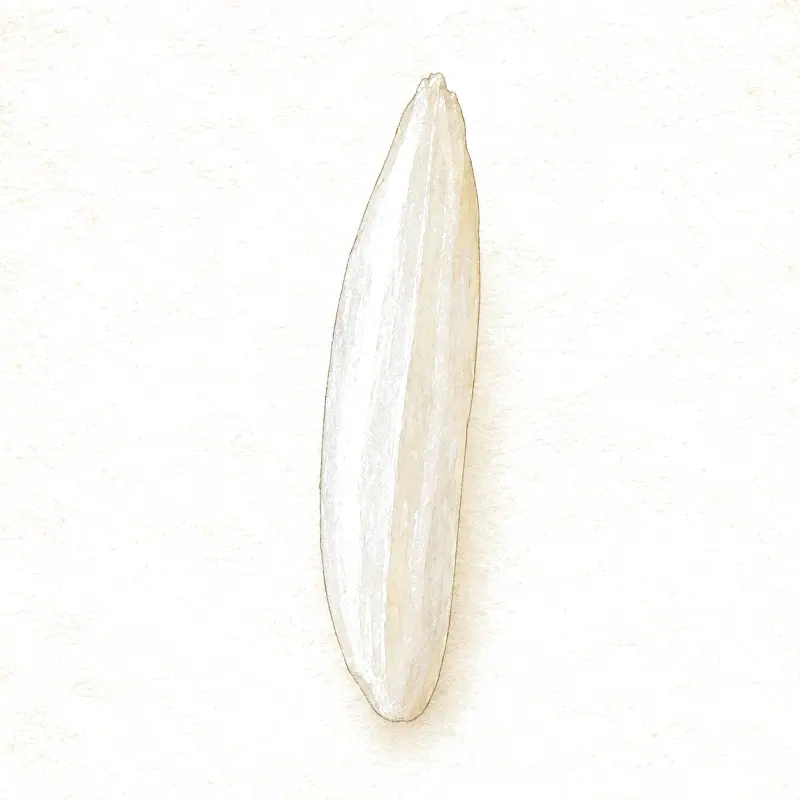
A 2011 study classifies Hashemi among local long-grain varieties and describes research material obtained through the Rice Research Institute of Iran in Rasht. Its measurements concern brown rice. This catalogue therefore keeps Hashemi separate from Tarom and does not copy brown-kernel or rough-rice dimensions into the polished-grain drawing. The displayed dimensions are explicit long-class illustration estimates.
What the flour experiment measured
Feizollahi and colleagues studied flour made from broken Hashemi kernels harvested in 2015. They report apparent amylose of 21.38 g per 100 g of flour for that sample and classify the studied flours as intermediate in amylose. This is not a percentage of isolated starch. Their work concerns gluten-free bread and dough, so its results cannot establish the texture of an ordinary pot of Hashemi rice.
Read the seed name carefully
An original Iranian field study lists Hashemi separately from Sang tarom, Tarom mahalli and Tarom deylamani. These are named experimental materials, so a shortened market name should not be treated as a certified seed-lot identity. The measurements on this page refer to the cited samples, rather than every rice sold under the name.
How it connects
Recipe
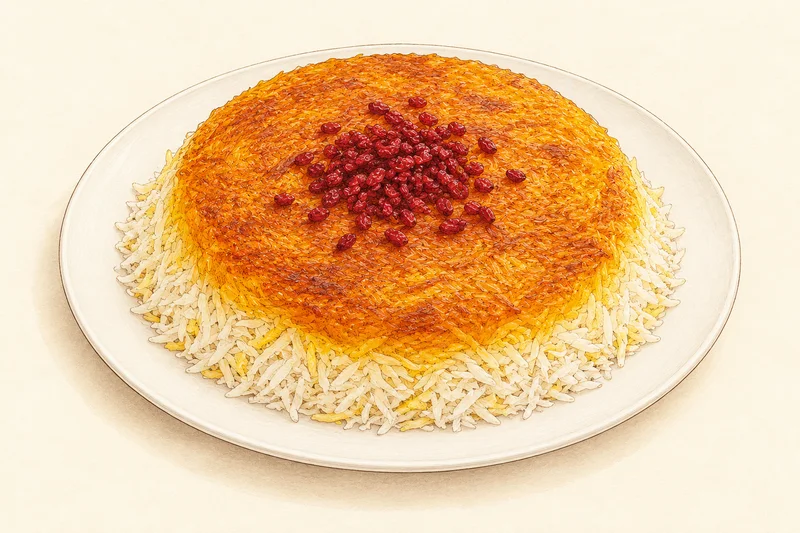
- related Chelow with tahdig