
Truffles
The underground fruiting bodies of the genus Tuber and the desert truffles of the Mediterranean and Middle East: where they grow, with which trees, when they are harvested, how they came to be cultivated, and how they are told apart in the trade.
Not an identification guide: never eat a wild mushroom or truffle on the strength of an illustration.
European truffles
7
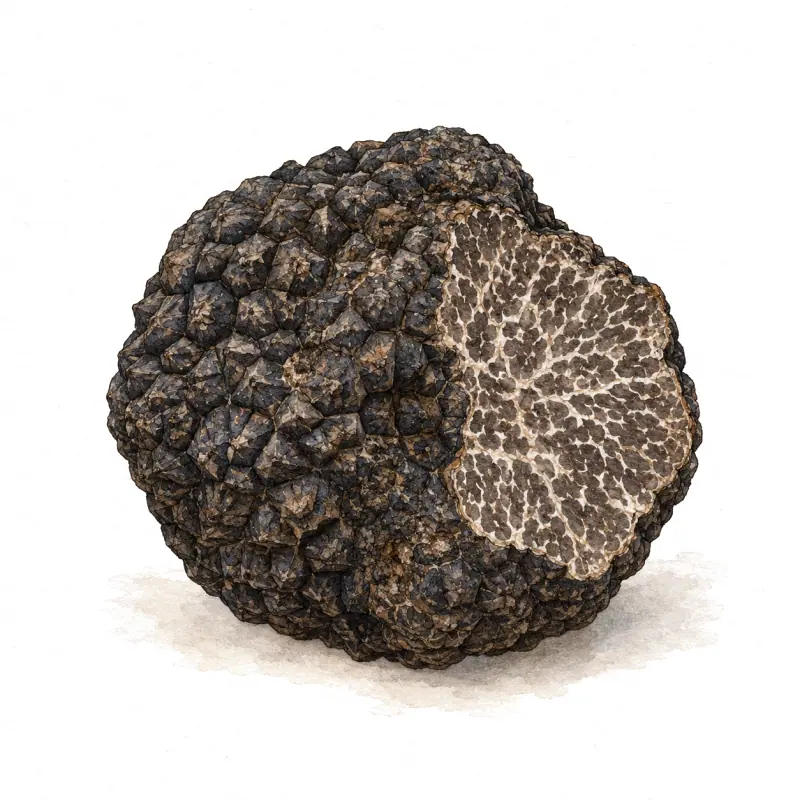
- TrufflePérigord black truffleTuber melanosporum
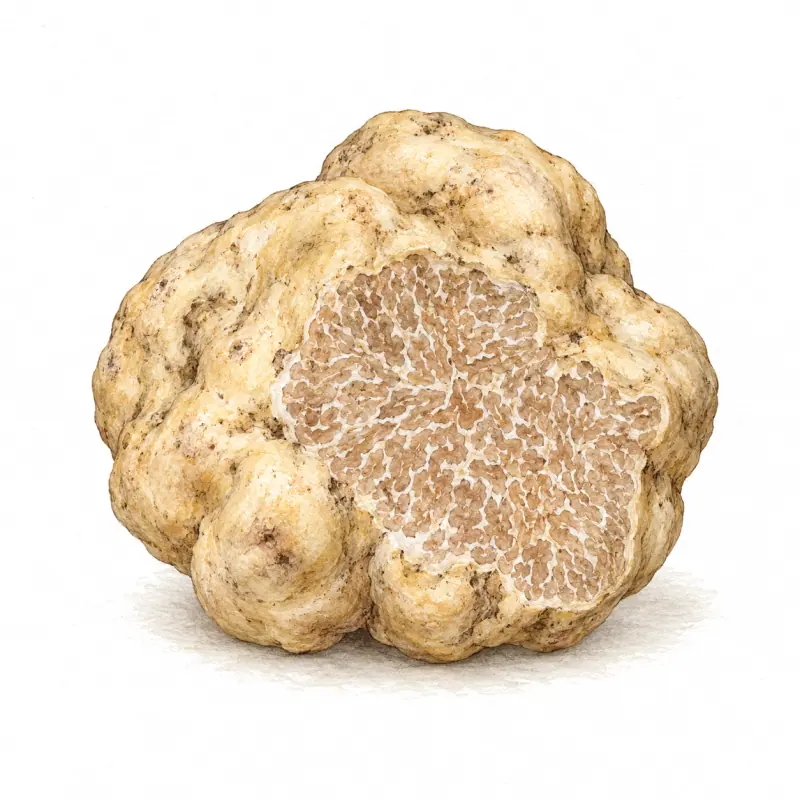 TruffleItalian white truffleTuber magnatum
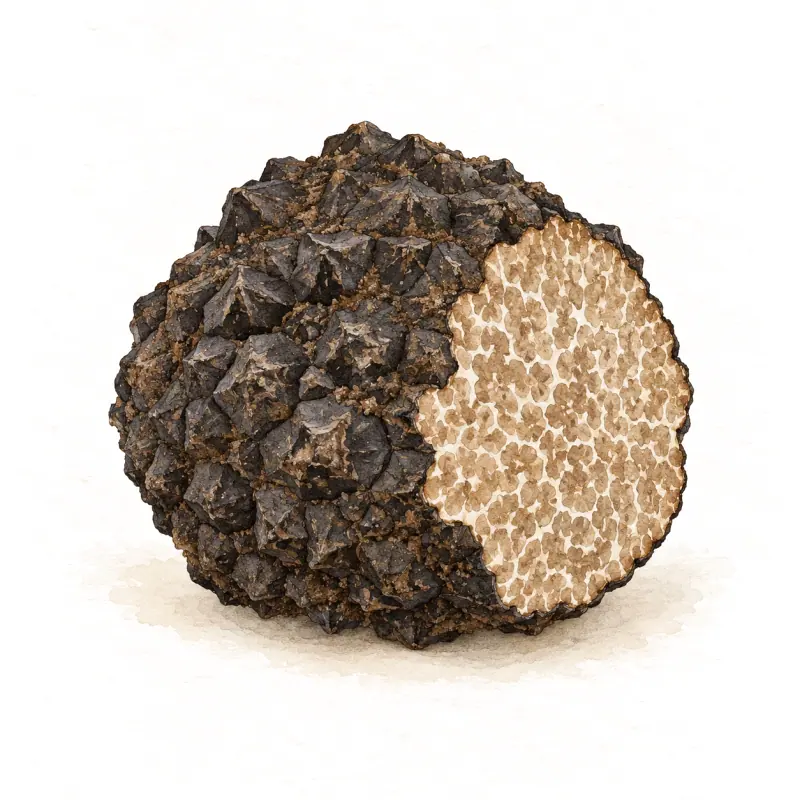 TruffleBurgundy truffle / summer truffleTuber aestivum
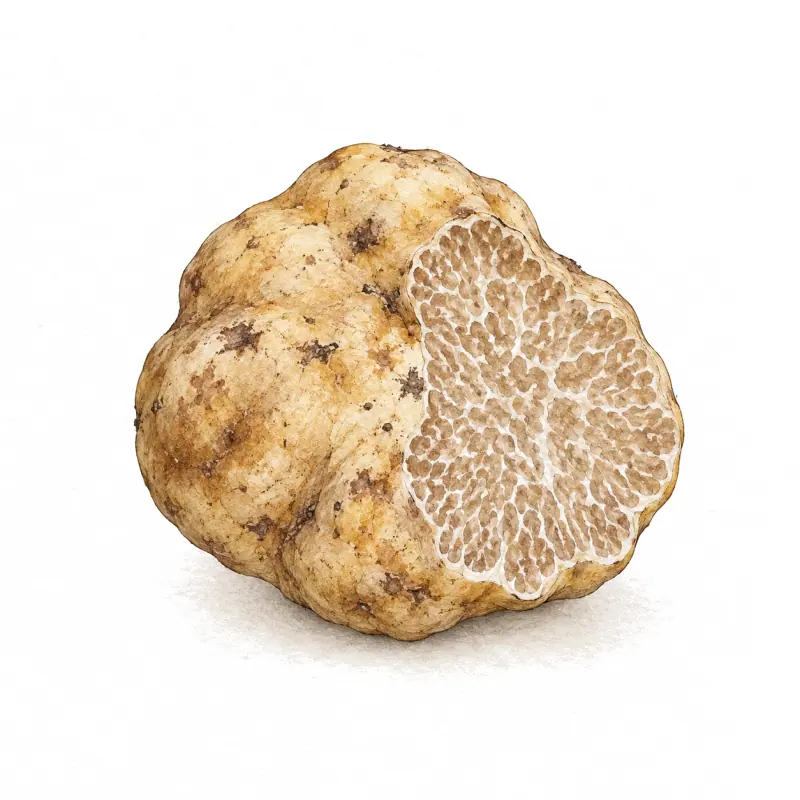 TruffleBianchetto truffleTuber borchii
- TruffleWinter truffleTuber brumale
- TruffleTuber mesentericumTuber mesentericum
- TruffleSmooth black truffleTuber macrosporum
Asian truffles
3
North American truffles
3
Desert truffles
2
Species notes
Périgord black truffle Tuber melanosporum
- Classification
- Tuberaceae, Pezizales, Ascomycota. Tuber melanosporum Vittad. is the accepted name in Index Fungorum (record 192144) and GBIF. Index Fungorum also lists T. brumale var. melanosporum (Vittad.) E. Fisch. as a synonym. Italian law calls it 'tartufo nero pregiato', also 'tartufo nero di Norcia o di Spoleto'.
- Host trees
- Ectomycorrhizal with trees. Holm oak (Quercus ilex) is the nursery host evaluated in Spanish seedling-quality work. In BC (Canada) and on pecan it has been grown on introduced hosts. A full natural host list was not found in the sources opened.
- Habitat
- An ectomycorrhizal symbiont endemic to calcareous soils in southern Europe (Martin et al. 2010). INRA/Académie d'agriculture material links natural truffle grounds to disturbed oak woodland. It says the collapse of the old coppice regime after rural exodus probably contributed to the decline in production.
- Where it grows
- Native range: southern Europe, with natural populations studied in France, Italy and Spain. In Spain there are 23 natural populations either side of the Iberian System. In France the DGCCRF (2022) names the Drôme, Vaucluse, Alpes-de-Haute-Provence and the South-West as the main producing areas. It is cultivated outside Europe in North America (incl. British Columbia), New Zealand, California, Chile, South Africa and Australasia.
- Season
- Italy (Law 752/1985): harvest 15 Nov–15 Mar, and the annex says it ripens mid-November to mid-March. France (DGCCRF 2022): harvested in winter, full maturity mid-December to January. These do not conflict: the Italian dates are a legal window, the French ones a peak.
- Cultivation
- Wild and cultivated. Truffles were cultivated empirically from the 19th century (Berlureau, in the INRA/Académie leaflet of 2015). Inoculated seedlings were first sold in 1973 (Murat 2015); the same leaflet dates the INRA–Agri-Truffe licence to 1972. INRA's 2015 figure is about 1,000 ha of new truffle plantations a year in France. Plantations now exist outside Europe (see regions).
- Aroma
- Italian law: 'delicate, very pleasant' scent. Review literature counts it among the most aromatic species, nicknamed the 'black diamond of cuisine'. Fresh specimens have the highest levels of dimethyl sulfide, 2-methylbutan-1-ol, 2-methylbutanal and 3-methylbutanal among the samples compared (Mustafa et al. 2020). Freezing markedly reduces the fresh aroma within 24 h. Bis(methylthio)methane, the white-truffle marker, is not present in black truffle (Tejedor-Calvo et al. 2023).
- In the kitchen
- French law reserves 'truffé' for foods made with T. melanosporum, T. brumale or T. magnatum, and 'au jus de truffe' for T. melanosporum or T. brumale juice (Décret 2012-129). DGCCRF advice: the truffle is very sensitive to cooking, so use it raw or barely cooked. For preserves, choose those marked 'première ébullition'.
- History
- French production collapsed through the 20th century. A nursery speaker in the 2015 INRA/Académie leaflet gives 1,500–2,000 t in 1910 against about 25 t in the mid-1970s, attributed to the nursery industry, not measured data. INRA research and inoculated seedlings stabilised production. Its ~125 Mb genome, sequenced in 2010, was then the largest fungal genome sequenced.
- Rules
- France: Décret 2012-129 (in force 1 July 2012). Fresh truffles must carry the usual name plus the Latin name, and 'truffé' is restricted as above. The arrêté of 19 March 2015 fixes its usual names as 'truffe noire', 'truffe noire du Périgord' and 'truffe du Périgord'; canned peelings or pieces mixing T. melanosporum and T. brumale may be sold as 'truffes d'hiver' if at least 30% is T. melanosporum. Italy: Law 752/1985 lists it among the nine Tuber taxa allowed for sale fresh and sets the harvest calendar, which regions may vary. No EU PDO/PGI was confirmed (EU register not checked).
- Lookalikes and fraud
- Its main substitutes are the cheaper T. indicum (Asian black truffle), which looks very similar but has a weaker, less complex aroma, and T. aestivum. T. brumale fruits at the same time and is a frequent contaminant of its orchards. Analyses of truffled products found undeclared T. aestivum and T. indicum. French law requires T. indicum to be sold as 'truffe de Chine'.
Sources: GBIF Backbone Taxonomy – species name-match API (Tuber, Terfezia, Tirmania names); Index Fungorum NameSearch web service; Legge 16 dicembre 1985, n. 752 – Normativa quadro in materia di raccolta, coltivazione e commercio dei tartufi (as amended by L. 162/1991); Décret n° 2012-129 du 30 janvier 2012 relatif à la mise sur le marché des truffes et des denrées alimentaires en contenant (JORF 31.01.2012); Fiche pratique 'Truffes' (DGCCRF, décembre 2022); La génomique au service de la gestion des truffières – séance de l'Académie d'agriculture de France, 11 février 2015 (programme and abstracts); Murat C. (2015) Forty years of inoculating seedlings with truffle fungi: past and future perspectives. Mycorrhiza 25:77–81; Martin F. et al. (2010) Périgord black truffle genome uncovers evolutionary origins and mechanisms of symbiosis. Nature 464:1033–1038; García-Cunchillos I. et al. (2014) Population genetics of the westernmost distribution of the glaciations-surviving black truffle Tuber melanosporum. Mycorrhiza 24 Suppl 1:S89–100; Andrés-Alpuente A. et al. (2014) Comparative analysis of different methods for evaluating quality of Quercus ilex seedlings inoculated with Tuber melanosporum. Mycorrhiza 24 Suppl 1:S29–37; Čejka T., Trnka M., Büntgen U. (2023) Sustainable cultivation of the white truffle (Tuber magnatum) requires ecological understanding. Mycorrhiza 33:291–302; Kinoshita A. et al. (2018) Using mating-type loci to improve taxonomy of the Tuber indicum complex, and discovery of a new species, T. longispinosum. PLoS ONE 13:e0193745; Berch S.M., Bonito G. (2014) Cultivation of Mediterranean species of Tuber (Tuberaceae) in British Columbia, Canada. Mycorrhiza 24:473–479; Mustafa A.M. et al. (2020) An overview on truffle aroma and main volatile compounds. Molecules 25:5948; Tejedor-Calvo E. et al. (2023) Truffle flavored commercial products veracity and sensory analysis from truffle and non-truffle consumers. Food Control (doi 10.1016/j.foodcont.2022.109424); Merényi Z. et al. (2014) Phylogeny and phylogeography of the Tuber brumale aggr. Mycorrhiza 24 Suppl 1:S101–113; Arrêté du 19 mars 2015 établissant une correspondance entre les noms usuels et scientifiques des truffes, pour l'application du décret n° 2012-129 du 30 janvier 2012 (NOR EINC1507389A, JORF n°0076 du 31 mars 2015)
Italian white truffle Tuber magnatum
- Classification
- Tuberaceae. Index Fungorum (record 184470) and GBIF give the authority as 'Picco'; many papers spell it 'Pico'. Italian law calls it 'tartufo bianco', also 'tartufo bianco del Piemonte o di Alba' and 'di Acqualagna'. Index Fungorum lists the infraspecific names var. magnatum and var. vittadinii Daprati.
- Host trees
- At least 26 potential host species from 12 genera are reported at white-truffle sites. Populus alba and Quercus cerris make up 23.5% of all plant species recorded (Čejka et al. 2023).
- Habitat
- Among 231 reviewed sites, all have mean winter temperatures above 0.4 °C and about 50 mm of summer rainfall. Soils have pH 6.4–8.7 and high macroporosity, and often formed in past flood or landslide events (Čejka et al. 2023).
- Where it grows
- Not endemic only to northern Italy. Natural habitats run from western Switzerland to eastern Bulgaria and from Sicily to Hungary. Of the reviewed sites, 25% are in Piedmont and 52% elsewhere in Italy. The rest are in Serbia, Croatia, Hungary, Romania, Bulgaria, Slovenia, Greece and Switzerland, with one site in northern Thailand. The first documented find in Russia was reported in 2025. Ascocarps were harvested in 2019–2020 from a French orchard outside the natural range.
- Season
- Italy (Law 752/1985): harvest 1 Oct–31 Dec, and the annex says it ripens from October to the end of December. Čejka et al. (2023) give the harvest season as 'September to December'. Flag: the starting month differs between the legal calendar and the review.
- Cultivation
- It comes overwhelmingly from natural habitats. Attempts to cultivate it began in the 1970s without success (Bach et al. 2021). In 2019 and 2020 the first ascocarps came from an orchard of inoculated plants in France, outside the natural range, starting 4.5 years after planting. Cultivation is not yet established practice.
- Aroma
- Italian law: 'strong, pleasant' scent. A review describes a complex aroma reminiscent of garlic and cheese (Mustafa et al. 2020). Bis(methylthio)methane (2,4-dithiapentane) is characteristic of white-truffle aroma and is widely used as a synthetic 'truffle' flavouring (Tejedor-Calvo et al. 2023).
- In the kitchen
- One of three species allowed to support the French term 'truffé' (Décret 2012-129). DGCCRF: prefer raw use, as the truffle is very sensitive to cooking.
- History
- Martin et al. (2010) describe the Piedmont white truffle and the Périgord black truffle as dominating the truffle market. An Italian income estimate exists (Čejka et al. 2023 citing Pieroni 2016), but no figure is adopted here.
- Rules
- Italy: Law 752/1985 (species no. 1, harvest calendar). France: one of the three species allowed for 'truffé' (Décret 2012-129). No EU PDO/PGI confirmed (EU register not checked).
- Lookalikes and fraud
- T. borchii (bianchetto) is used as a cheaper substitute in 'white truffle' products (Tejedor-Calvo et al. 2023, citing Oliach et al. 2021). Bis(methylthio)methane is often added as a flavouring to products sold with white-truffle claims.
Sources: GBIF Backbone Taxonomy – species name-match API (Tuber, Terfezia, Tirmania names); Index Fungorum NameSearch web service; Legge 16 dicembre 1985, n. 752 – Normativa quadro in materia di raccolta, coltivazione e commercio dei tartufi (as amended by L. 162/1991); Décret n° 2012-129 du 30 janvier 2012 relatif à la mise sur le marché des truffes et des denrées alimentaires en contenant (JORF 31.01.2012); Fiche pratique 'Truffes' (DGCCRF, décembre 2022); Čejka T., Trnka M., Büntgen U. (2023) Sustainable cultivation of the white truffle (Tuber magnatum) requires ecological understanding. Mycorrhiza 33:291–302; Bach C. et al. (2021) First production of Italian white truffle (Tuber magnatum Pico) ascocarps in an orchard outside its natural range distribution in France. Mycorrhiza 31:383–388; Malygina E.V. et al. (2025) Microbial communities inhabiting the surface and gleba of white (Tuber magnatum) and black (Tuber macrosporum) truffles from Russia. PeerJ 13:e20037; Martin F. et al. (2010) Périgord black truffle genome uncovers evolutionary origins and mechanisms of symbiosis. Nature 464:1033–1038; Mustafa A.M. et al. (2020) An overview on truffle aroma and main volatile compounds. Molecules 25:5948; Tejedor-Calvo E. et al. (2023) Truffle flavored commercial products veracity and sensory analysis from truffle and non-truffle consumers. Food Control (doi 10.1016/j.foodcont.2022.109424)
Burgundy truffle / summer truffle Tuber aestivum
- Classification
- Tuberaceae. Treated here as ONE species including the 'uncinatum' form. Paolocci et al. (2004) found that T. uncinatum and T. aestivum belong to the same species, with no morphotype-specific molecular fingerprint. They concluded that ecological, not genetic, causes probably explain the differences in spores, taste and smell. GBIF gives T. uncinatum Chatin as a synonym of T. aestivum. Index Fungorum records the infraspecific name T. aestivum f. uncinatum (Chatin) Montecchi & Borelli. Steidinger et al. (2022) write 'T. aestivum Vittad. syn. T. uncinatum Chatin'. Authority conflict: Index Fungorum's current record is 'T. aestivum Vittad.' (218597); GBIF's match is 'T. aestivum (Wulfen) Spreng.'. Index Fungorum points the Wulfen/Sprengel name to Rhizopogon aestivus.
- Host trees
- Long-term monitored productive sites in SW Germany and Switzerland are dominated by Fagus sylvatica, Carpinus betulus, Corylus avellana or Ostrya carpinifolia (Steidinger et al. 2022).
- Habitat
- It has a broad climatic niche, fruiting from the hot, dry climates of Spain to the cold temperate climates of Scandinavia. Monitored soils had pH (H2O) of about 6.5–8.2. Fruiting is sensitive to summer drought: yearly truffle mass fell a median 22% for each +1 °C of summer temperature.
- Where it grows
- Widely distributed in Europe, from Spain to Scandinavia (Steidinger et al. 2022). It is harvested in Italy and France under national rules. It has been planted and has fruited in British Columbia, Canada (Berch & Bonito 2014).
- Season
- Italy (Law 752/1985): T. aestivum harvest 1 May–30 Nov (annex: ripens June–November). 'var. uncinatum' harvest 1 Oct–31 Dec (annex: ripens September–November). France (DGCCRF, December 2025): 'truffe d'été' (T. aestivum) is harvested May–July, and 'truffe de Bourgogne' or 'truffe d'automne' (T. aestivum var. uncinatum) September–December. Correction: DGCCRF's December 2022 leaflet attached 'truffe de Bourgogne' to the summer form; the arrêté of 19 March 2015 reserves 'truffe de Bourgogne' and 'truffe d'automne' for var. uncinatum. Flag: the Italian legal harvest window for T. aestivum (May–November) is much longer than the French summer season.
- Cultivation
- Wild and cultivated. Cultivated in various countries alongside T. melanosporum and T. borchii (Mustafa et al. 2020). Its broad niche, long fruiting period and market value make it attractive for cultivation (Steidinger et al. 2022).
- Aroma
- Italian law: T. aestivum has a 'weak scent', the uncinatum form a 'pleasant scent'. A review rates the summer truffle as less aromatic than T. melanosporum but of good, well-liked aroma quality (Mustafa et al. 2020). Concentrations of C8 volatiles vary with genotype.
- In the kitchen
- Not allowed to support the French term 'truffé' (Décret 2012-129). Products naming it must give the usual name and a truffle content above 1%. Found undeclared in many 'black truffle' products (Tejedor-Calvo et al. 2023).
- History
- Steidinger et al. (2022) report a 'fall of the summer truffle': recurring hot, dry summers reduced fruiting in Central Europe in 2011–2018 monitoring.
- Rules
- Italy: Law 752/1985 lists T. aestivum and 'T. aestivum var. uncinatum' as separate commercial taxa, each with its own season (legal categories, not taxonomy). France: Décret 2012-129 labelling rules apply; the arrêté of 19 March 2015 gives T. aestivum the usual names 'truffe de la Saint Jean', 'truffe d'été' and 'truffe blanche d'été', and var. uncinatum 'truffe de Bourgogne' and 'truffe d'automne'.
- Lookalikes and fraud
- Widely used as a cheaper stand-in for T. melanosporum in 'black truffle' products. The Chinese species T. sinoaestivum has been misidentified as T. aestivum (Zhang et al. 2013).
Sources: GBIF Backbone Taxonomy – species name-match API (Tuber, Terfezia, Tirmania names); Index Fungorum NameSearch web service; Tuber aestivum and Tuber uncinatum: two morphotypes or two species? (Paolocci, Rubini, Riccioni, Topini, Arcioni), FEMS Microbiology Letters 235(1):109–115; Steidinger B.S. et al. (2022) The fall of the summer truffle: recurring hot, dry summers result in declining fruitbody production of Tuber aestivum in Central Europe. Global Change Biology 28:7376–7390; Legge 16 dicembre 1985, n. 752 – Normativa quadro in materia di raccolta, coltivazione e commercio dei tartufi (as amended by L. 162/1991); Fiche pratique 'Truffes' (DGCCRF, décembre 2022); Décret n° 2012-129 du 30 janvier 2012 relatif à la mise sur le marché des truffes et des denrées alimentaires en contenant (JORF 31.01.2012); Berch S.M., Bonito G. (2014) Cultivation of Mediterranean species of Tuber (Tuberaceae) in British Columbia, Canada. Mycorrhiza 24:473–479; Mustafa A.M. et al. (2020) An overview on truffle aroma and main volatile compounds. Molecules 25:5948; Tejedor-Calvo E. et al. (2023) Truffle flavored commercial products veracity and sensory analysis from truffle and non-truffle consumers. Food Control (doi 10.1016/j.foodcont.2022.109424); Zhang J.-P., Liu P.-G., Chen J. (2013) Tuber sinoaestivum sp. nov., an edible truffle from southwestern China. Mycotaxon 122:73–82; Arrêté du 19 mars 2015 établissant une correspondance entre les noms usuels et scientifiques des truffes, pour l'application du décret n° 2012-129 du 30 janvier 2012 (NOR EINC1507389A, JORF n°0076 du 31 mars 2015); Truffes et produits truffés : bien choisir son produit (DGCCRF consumer page, written 19/12/2025)
Bianchetto truffle Tuber borchii
- Classification
- Tuberaceae. Index Fungorum (record 118774) and GBIF accept it. Index Fungorum gives Tuber albidum Picco as a synonym whose current name is T. borchii. Italian law lists it as 'Tuber Borchii Vitt. o Tuber albidum Pico', called 'bianchetto' or 'marzuolo'. Those are one species, not two.
- Host trees
- Low host specificity. Recorded with Pinus sylvestris (Mrak et al. 2024) and with Pinus pinea and oaks in plantation (Ori et al. 2023). Grows across a wide range of soils.
- Habitat
- A wide range of soils (Mrak et al. 2024). In a plantation outside its natural area, production fell sharply from 2016 to 2021 as native T. maculatum ectomycorrhizae increased (Ori et al. 2023).
- Where it grows
- Native across Europe from the Mediterranean to central Finland and from Ireland to Hungary. Recent records come from Iran. It has been introduced through cultivation overseas and is grown successfully at least in New Zealand, Australia and the USA (Mrak et al. 2024).
- Season
- Italy (Law 752/1985): harvest 15 Jan–30 Apr; the annex says it ripens mid-January to mid-April.
- Cultivation
- Cultivated, and popular in recent years (Ori et al. 2023). Grown in plantations outside Europe (NZ, AU, USA); few plantations in Europe (Mrak et al. 2024). A draft genome was published in 2018.
- Aroma
- Italian law: scent 'tending somewhat to garlic'. It shares a garlic-like odour and some aromas with T. magnatum, and is 'undervalued in trading and culinary' use (Mrak et al. 2024).
- In the kitchen
- Not one of the 'truffé' species under French law. Used as a cheaper substitute in 'white truffle' products (Tejedor-Calvo et al. 2023).
- Rules
- Italy: Law 752/1985 (species no. 7, harvest calendar).
- Lookalikes and fraud
- Sold or used in products in place of T. magnatum. Distinguished from T. magnatum by species-level labelling and microscopy under Italian law.
Sources: GBIF Backbone Taxonomy – species name-match API (Tuber, Terfezia, Tirmania names); Index Fungorum NameSearch web service; Legge 16 dicembre 1985, n. 752 – Normativa quadro in materia di raccolta, coltivazione e commercio dei tartufi (as amended by L. 162/1991); Mrak T. et al. (2024) Description, identification, and growth of Tuber borchii Vittad. mycorrhized Pinus sylvestris L. seedlings on different lime contents. Mycorrhiza 34:85–94; Ori F. et al. (2023) Ectomycorrhizal fungal community and ascoma production in a declining Tuber borchii plantation. Journal of Fungi 9:678; Murat C. et al. (2018) Draft genome sequence of Tuber borchii Vittad., a whitish edible truffle. Genome Announcements 6:e00537-18; Tejedor-Calvo E. et al. (2023) Truffle flavored commercial products veracity and sensory analysis from truffle and non-truffle consumers. Food Control (doi 10.1016/j.foodcont.2022.109424); Décret n° 2012-129 du 30 janvier 2012 relatif à la mise sur le marché des truffes et des denrées alimentaires en contenant (JORF 31.01.2012)
Winter truffle Tuber brumale
- Classification
- Tuberaceae, Melanosporum group. Index Fungorum (228019) and GBIF accept it. Italian law treats 'T. brumale var. moschatum De Ferry' ('tartufo moscato') as a separate commercial taxon. Index Fungorum lists var. moschatum among infraspecific names, so it is not counted as a separate species here. Phylogeography found two phylogenetic species in the T. brumale aggregate, one apparently endemic to the Carpathian Basin (Merényi et al. 2014). Its formal naming has not been checked.
- Host trees
- Shares hosts with T. melanosporum. It is a frequent contaminant of Périgord-truffle orchards and occasionally of summer-truffle orchards. Pecan has been mycorrhized with it experimentally.
- Where it grows
- Reported from most European countries (Merényi et al. 2014). It is harvested in France in winter alongside T. melanosporum (DGCCRF). It was introduced accidentally into North America: British Columbia (2014), North Carolina (2020), and orchards in six eastern US states (2021 harvest).
- Season
- Italy (Law 752/1985): T. brumale harvest 1 Jan–15 Mar (annex: ripens January to end of March). var. moschatum harvest 15 Nov–15 Mar (annex: ripens February–March). France (DGCCRF 2022): harvested in winter, full maturity mid-December to January. Flag: the sources disagree on when it is ripe.
- Cultivation
- Not intentionally cultivated in North America, where it arrives as a contaminant of T. melanosporum inoculum (Lemmond et al. 2023). Orchard managers in Europe treat it as an unwanted competitor of T. melanosporum.
- Aroma
- Italian law: T. brumale gives off 'little scent'; var. moschatum has a 'strong scent and piquant taste'. A review describes a characteristic musky odour with earthy notes (Mustafa et al. 2020). Merényi et al. (2014) call its fragrance 'delicate' and its trade 'worthy of note'.
- In the kitchen
- France: one of the three species allowed for 'truffé', with the usual name 'truffe brumale'. It and T. melanosporum are the only species allowed for 'au jus de truffe' (Décret 2012-129).
- Rules
- France: Décret 2012-129; the arrêté of 19 March 2015 fixes 'truffe brumale' for T. brumale and 'truffe musquée' for var. moschatum. Italy: Law 752/1985 (T. brumale and var. moschatum).
- Lookalikes and fraud
- Looks like T. melanosporum but differs in aroma and flavour and sells for much less (Lemmond et al. 2023). Its spores are smaller and less dark than those of T. melanosporum (Italian law annex). Rapid DNA (LAMP) assays exist to detect it.
Sources: GBIF Backbone Taxonomy – species name-match API (Tuber, Terfezia, Tirmania names); Index Fungorum NameSearch web service; Merényi Z. et al. (2014) Phylogeny and phylogeography of the Tuber brumale aggr. Mycorrhiza 24 Suppl 1:S101–113; Lemmond B. et al. (2023) Accidental cultivation of the European truffle Tuber brumale in North American truffle orchards. Mycorrhiza 33:221–228; Sow A. et al. (2026) Rapid detection of cultivated truffle fungi (Tuber) from truffles and ectomycorrhizal root tips using loop-mediated isothermal amplification. Applied and Environmental Microbiology 92:e0155926; Legge 16 dicembre 1985, n. 752 – Normativa quadro in materia di raccolta, coltivazione e commercio dei tartufi (as amended by L. 162/1991); Décret n° 2012-129 du 30 janvier 2012 relatif à la mise sur le marché des truffes et des denrées alimentaires en contenant (JORF 31.01.2012); Fiche pratique 'Truffes' (DGCCRF, décembre 2022); Mustafa A.M. et al. (2020) An overview on truffle aroma and main volatile compounds. Molecules 25:5948; Arrêté du 19 mars 2015 établissant une correspondance entre les noms usuels et scientifiques des truffes, pour l'application du décret n° 2012-129 du 30 janvier 2012 (NOR EINC1507389A, JORF n°0076 du 31 mars 2015)
Tuber mesentericum Tuber mesentericum
- Classification
- Tuberaceae. Index Fungorum (180551) and GBIF accept it. Leonardi et al. (2021) found three cryptic lineages in the 'T. mesentericum complex', named T. mesentericum s.s. (epitype designated), T. bituminatum and T. suave sp. nov. They cannot be told apart reliably by morphology. Commercial 'mesentericum' may therefore include more than one species. Italian law calls it 'tartufo nero ordinario', also 'tartufo nero di Bagnoli'.
- Where it grows
- Southern Italy is its major production area (Sica et al. 2007). In the complex, clade I is widespread across Europe, clade II comes mainly from the Iberian, Italian and Balkan peninsulas, and clade III almost only from central Italy.
- Season
- Italy (Law 752/1985): harvest 1 Sep–31 Jan; the annex says it ripens from September to early May. Flag: the ripening period extends beyond the legal window.
- Aroma
- Italian law: 'weak scent'. 3-Methylanisole is typical of T. mesentericum. It has a strong, unpleasant spicy odour likened to car paint (Mustafa et al. 2020). Leonardi et al. (2021) say the complex's aroma profiles still need defining.
- In the kitchen
- Sica et al. (2007) describe increasing market demand in southern Italy. No specific traditional preparations were found in the sources opened.
- Rules
- Italy: Law 752/1985 (species no. 9). France: the arrêté of 19 March 2015 fixes the usual name 'truffe mésentérique'.
- Lookalikes and fraud
- Cryptic species within the complex (see taxonomy).
Sources: GBIF Backbone Taxonomy – species name-match API (Tuber, Terfezia, Tirmania names); Index Fungorum NameSearch web service; Leonardi M. et al. (2021) Multilocus phylogeography of the Tuber mesentericum complex unearths three highly divergent cryptic species. Journal of Fungi 7:1090; Sica M., Gaudio L., Aceto S. (2007) Genetic structure of Tuber mesentericum Vitt. based on polymorphisms at the ribosomal DNA ITS. Mycorrhiza 17:405–414; Legge 16 dicembre 1985, n. 752 – Normativa quadro in materia di raccolta, coltivazione e commercio dei tartufi (as amended by L. 162/1991); Mustafa A.M. et al. (2020) An overview on truffle aroma and main volatile compounds. Molecules 25:5948; Arrêté du 19 mars 2015 établissant une correspondance entre les noms usuels et scientifiques des truffes, pour l'application du décret n° 2012-129 du 30 janvier 2012 (NOR EINC1507389A, JORF n°0076 du 31 mars 2015)
Smooth black truffle Tuber macrosporum
- Classification
- Tuberaceae. Index Fungorum (190290) and GBIF accept it. Italian law calls it 'tartufo nero liscio'.
- Host trees
- Under greenhouse inoculation, Quercus robur took best and Corylus avellana weakly; Q. cerris formed none (Benucci et al. 2012).
- Habitat
- Natural and cultivated productive sites have been compared; T. macrosporum was the only ectomycorrhizal taxon common to both (Benucci et al. 2014).
- Where it grows
- Studied in Italy. Specimens were also reported from Russia in 2025 (Malygina et al. 2025).
- Season
- Italy (Law 752/1985): harvest 1 Sep–31 Dec; the annex says it ripens August–October. Flag: the ripening period starts before the legal harvest window.
- Cultivation
- Cultivation is 'still in its infancy' (Benucci et al. 2014). Species-specific PCR primers were developed to certify inoculated seedlings (Benucci et al. 2011).
- Aroma
- Italian law: 'pleasant, rather strong garlicky scent'. 1-(Methylthio)propane, an alliaceous, leek-like compound, has been reported only in T. macrosporum (Mustafa et al. 2020). Benucci et al. describe 'remarkable' and 'superb' organoleptic qualities.
- Rules
- Italy: Law 752/1985 (species no. 8).
Sources: GBIF Backbone Taxonomy – species name-match API (Tuber, Terfezia, Tirmania names); Index Fungorum NameSearch web service; Legge 16 dicembre 1985, n. 752 – Normativa quadro in materia di raccolta, coltivazione e commercio dei tartufi (as amended by L. 162/1991); Benucci G.M.N. et al. (2011) Species-specific primers for the identification of the ectomycorrhizal fungus Tuber macrosporum Vittad. Molecular Ecology Resources 11:378–381; Benucci G.M.N. et al. (2012) Mycorrhization of Quercus robur L., Quercus cerris L. and Corylus avellana L. seedlings with Tuber macrosporum Vittad. Mycorrhiza 22:639–646; Benucci G.M.N. et al. (2014) Assessment of ectomycorrhizal biodiversity in Tuber macrosporum productive sites. Mycorrhiza 24:281–292; Malygina E.V. et al. (2025) Microbial communities inhabiting the surface and gleba of white (Tuber magnatum) and black (Tuber macrosporum) truffles from Russia. PeerJ 13:e20037; Mustafa A.M. et al. (2020) An overview on truffle aroma and main volatile compounds. Molecules 25:5948
Asian black truffle Tuber indicum
- Classification
- Tuberaceae, Melanosporum group. Index Fungorum (188017) and GBIF accept it. Delimiting the 'T. indicum complex' is CONTESTED. Wang et al. (2006) lumped T. indicum, T. himalayense, T. sinense and T. pseudohimalayense into one species, with two Chinese 'ecotypes' (groups A and B). Chen et al. (2011) treated T. sinense as a synonym of T. indicum. They found T. pseudohimalayense = T. pseudoexcavatum, kept T. formosanum separate, and showed T. indicum holds at least two phylogenetic species. Kinoshita et al. (2018) followed the split of group A = T. indicum and group B = T. himalayense. They synonymised T. formosanum with T. himalayense and described T. longispinosum from Japan. This file follows the 2018 split: T. himalayense is a separate entry, and T. sinense is a synonym here, not an entry.
- Host trees
- Hosts of sequenced Chinese specimens included Pinus armandii, P. yunnanensis, Cyclobalanopsis glauca and Castanea mollissima (Chen et al. 2011).
- Habitat
- Yunnan and Sichuan in the Hengduan Mountains, a biodiversity hotspot (Chen et al. 2011).
- Where it grows
- SW China, mainly Yunnan and Sichuan. Asian black truffles have been imported into Europe since the early 1990s and sold at local markets (Kinoshita et al. 2018).
- Cultivation
- Wild-harvested. It has turned up as an unwanted contaminant in truffle-orchard inoculum (Sow et al. 2026). It was found in an Italian truffle ground in Piedmont, both in the soil and as ectomycorrhizas (Murat et al. 2008).
- Aroma
- A less intense and less complex aroma than T. melanosporum. 3-Methylanisole is reported as typical (Mustafa et al. 2020).
- In the kitchen
- France requires the sales name 'truffe de Chine' (DGCCRF 2022). It is not allowed to support 'truffé' (Décret 2012-129).
- History
- Imported into Europe since the early 1990s (Kinoshita et al. 2018). Moreno et al. (1997) described T. pseudohimalayense from material sold in Spain, cited in Chen et al. (2011).
- Rules
- France: the arrêté of 19 March 2015 gives the usual names 'truffe de Chine' or 'truffe d'Asie'; DGCCRF guidance (2022, 2025) says it must be called 'truffe de Chine'. It is not on Italy's list of nine taxa allowed for sale fresh (Law 752/1985 Art. 2), so fresh sale of other types is prohibited there.
- Lookalikes and fraud
- FRAUD: it looks very similar to T. melanosporum and is a known substitute in fresh and processed 'black truffle' products. Chen et al. (2011) note that T. aestivum-like truffles from Sichuan were marketed as T. indicum; that material was later described as T. sinoaestivum.
Sources: GBIF Backbone Taxonomy – species name-match API (Tuber, Terfezia, Tirmania names); Index Fungorum NameSearch web service; Wang Y. et al. (2006) Phylogenetic and populational study of the Tuber indicum complex. Mycological Research 110:1034–1045; Chen J., Guo S.-X., Liu P.-G. (2011) Species recognition and cryptic species in the Tuber indicum complex. PLoS ONE 6:e14625; Kinoshita A. et al. (2018) Using mating-type loci to improve taxonomy of the Tuber indicum complex, and discovery of a new species, T. longispinosum. PLoS ONE 13:e0193745; Mustafa A.M. et al. (2020) An overview on truffle aroma and main volatile compounds. Molecules 25:5948; Fiche pratique 'Truffes' (DGCCRF, décembre 2022); Décret n° 2012-129 du 30 janvier 2012 relatif à la mise sur le marché des truffes et des denrées alimentaires en contenant (JORF 31.01.2012); Legge 16 dicembre 1985, n. 752 – Normativa quadro in materia di raccolta, coltivazione e commercio dei tartufi (as amended by L. 162/1991); Tejedor-Calvo E. et al. (2023) Truffle flavored commercial products veracity and sensory analysis from truffle and non-truffle consumers. Food Control (doi 10.1016/j.foodcont.2022.109424); Sow A. et al. (2026) Rapid detection of cultivated truffle fungi (Tuber) from truffles and ectomycorrhizal root tips using loop-mediated isothermal amplification. Applied and Environmental Microbiology 92:e0155926; Murat C., Zampieri E., Vizzini A., Bonfante P. (2008) Is the Perigord black truffle threatened by an invasive species? We dreaded it and it has happened! New Phytologist 178:699–702; Arrêté du 19 mars 2015 établissant une correspondance entre les noms usuels et scientifiques des truffes, pour l'application du décret n° 2012-129 du 30 janvier 2012 (NOR EINC1507389A, JORF n°0076 du 31 mars 2015); Truffes et produits truffés : bien choisir son produit (DGCCRF consumer page, written 19/12/2025)
Asian black truffle Tuber himalayense
- Classification
- Tuberaceae, T. indicum complex. Accepted in Index Fungorum (134661) and GBIF. It equals 'T. indicum group B'. Kinoshita et al. (2018) made T. formosanum H.T. Hu & Y. Wang and Japanese 'Tuber sp. 6' its synonyms. Wang et al. (2006) instead included it in T. indicum. CONTESTED; see tuber-indicum.
- Host trees
- Betula and Carpinus (Betulaceae); Castanea, Castanopsis and Quercus (Fagaceae); Abies and Pinus (Pinaceae) (Kinoshita et al. 2018). It has been mycorrhized on Quercus acutissima and Q. dentata in Korea, and fruited on Q. serrata in Japan.
- Habitat
- Woodland (Kinoshita et al. 2018).
- Where it grows
- From north-western India to southern China, Taiwan and Japan (Kinoshita et al. 2018). Recently reported from Korea (Gwon et al. 2022).
- Season
- In Japan it fruits from July to January (Kinoshita et al. 2018).
- Cultivation
- Commercially harvested from natural habitats, where populations have declined since the 1990s through habitat degradation and overharvesting. First cultivated in Japan: Quercus serrata seedlings inoculated with spores produced ascomata after about 7.5 years (Kitade et al. 2026).
- Lookalikes and fraud
- Part of the 'Asian black truffle' trade category. Sold alongside T. indicum and morphologically hard to separate from it.
Sources: GBIF Backbone Taxonomy – species name-match API (Tuber, Terfezia, Tirmania names); Index Fungorum NameSearch web service; Kinoshita A. et al. (2018) Using mating-type loci to improve taxonomy of the Tuber indicum complex, and discovery of a new species, T. longispinosum. PLoS ONE 13:e0193745; Chen J., Guo S.-X., Liu P.-G. (2011) Species recognition and cryptic species in the Tuber indicum complex. PLoS ONE 6:e14625; Wang Y. et al. (2006) Phylogenetic and populational study of the Tuber indicum complex. Mycological Research 110:1034–1045; Kitade Y. et al. (2026) Sustained ascoma production and reproductive dynamics of the Asian black truffle Tuber himalayense in Japan. Mycologia 118:915–925; Gwon J.H., Park H., Eom A.H. (2022) Mycorrhization of Quercus spp. with Tuber huidongense and T. himalayense collected in Korea. Mycobiology 50:104–109
Tuber sinoaestivum Tuber sinoaestivum
- Classification
- Tuberaceae. Index Fungorum (563565) and GBIF accept it. Described in 2013 from SW China. It had previously been misidentified as T. aestivum (= T. uncinatum). It differs by more globose spores with a shallower reticulum and only ~92% ITS similarity to T. aestivum (Zhang et al. 2013). It is an aestivum-like species, NOT a member of the T. indicum / T. himalayense complex.
- Host trees
- Pinus armandii (Zhang et al. 2013).
- Where it grows
- South-western China.
- In the kitchen
- Described as edible (title of Zhang et al. 2013).
- Lookalikes and fraud
- Can be confused with European T. aestivum. Chen et al. (2011) record T. aestivum-like Sichuan material 'usually marketed as T. indicum'.
Sources: GBIF Backbone Taxonomy – species name-match API (Tuber, Terfezia, Tirmania names); Index Fungorum NameSearch web service; Zhang J.-P., Liu P.-G., Chen J. (2013) Tuber sinoaestivum sp. nov., an edible truffle from southwestern China. Mycotaxon 122:73–82; Chen J., Guo S.-X., Liu P.-G. (2011) Species recognition and cryptic species in the Tuber indicum complex. PLoS ONE 6:e14625
Oregon winter white truffle Tuber oregonense
- Classification
- Tuberaceae, Gibbosum clade. Described in 2010 when the T. gibbosum complex was split into four species (Bonito et al. 2010). Accepted in Index Fungorum (515123) and GBIF. Traded together with T. gibbosum as 'Oregon white truffles'.
- Host trees
- Douglas-fir (Pseudotsuga menziesii). The gourmet species are found only near Douglas-firs (OSU Extension 2023).
- Habitat
- Young to early-mature Douglas-fir stands, often planted on former pasture, from sea level to about 2,000 ft. Sometimes fruits abundantly in early successional regrowth.
- Where it grows
- West of the Cascade Range and the coastal ranges, from northern California to southern British Columbia.
- Season
- October to February (OSU Extension 2023).
- Cultivation
- Wild-harvested with dogs or by raking. OSU advises against large raked areas and says to replace the duff.
- Aroma
- Often has little aroma at harvest. The odour develops 1–3 days later and is described as a complex mix of garlic, spices and cheese, more intense than T. gibbosum (OSU Extension 2023).
- In the kitchen
- Shaved thin and uncooked over warm, fatty foods such as eggs, meat, butter or cream sauces. Also used to infuse fats such as cheese, butter and eggs in a sealed container (OSU Extension 2023).
- History
- Formerly included in a broad 'T. gibbosum' thought to fruit from autumn to spring (Bonito et al. 2010).
- Lookalikes and fraud
- Many non-gourmet truffles occur in Oregon. OSU says the gourmet ones are firm, solid and marbled inside, and that spongy, hollow or powdery truffles should not be eaten.
Sources: GBIF Backbone Taxonomy – species name-match API (Tuber, Terfezia, Tirmania names); Index Fungorum NameSearch web service; Bonito G., Trappe J.M., Rawlinson P., Vilgalys R. (2010) Improved resolution of major clades within Tuber and taxonomy of species within the Tuber gibbosum complex. Mycologia 102:1042–1057; Benucci G.M.N., Lefevre C., Bonito G. (2016) Characterizing root-associated fungal communities and soils of Douglas-fir stands that naturally produce Oregon white truffles. Mycorrhiza 26:367–376; Oregon Native Edible Truffles (EM 9369, July 2023), A. Christiansen & T. Hopkins; Berch S.M., Bonito G. (2016) Truffle diversity (Tuber, Tuberaceae) in British Columbia. Mycorrhiza 26:587–594
Oregon spring white truffle Tuber gibbosum
- Classification
- Tuberaceae, Gibbosum clade. Described from northern California. It was once treated as one variable species fruiting autumn to spring. In 2010 it was split into four species: T. gibbosum s.s., T. oregonense, T. bellisporum and T. castellanoi (Bonito et al. 2010). Accepted in Index Fungorum (190404) and GBIF.
- Host trees
- Douglas-fir (Pseudotsuga menziesii).
- Habitat
- As for T. oregonense: young Douglas-fir stands west of the Cascades.
- Where it grows
- Commercially harvested in the north-western USA. Range as for T. oregonense; also recorded in British Columbia (Berch & Bonito 2016).
- Season
- January to June (OSU Extension 2023).
- Cultivation
- Wild-harvested.
- Aroma
- A complex garlic, spice and cheese aroma that is often undetectable at harvest. Less intense than T. oregonense (OSU Extension 2023).
- In the kitchen
- As for T. oregonense: shaved raw over warm, fatty dishes (OSU Extension 2023).
- History
- Popular as a culinary truffle in the north-western USA (Bonito et al. 2010).
- Rules
- France: the arrêté of 19 March 2015 fixes the usual name 'truffe de l'Oregon' for T. gibbosum. It names no other North American species.
- Lookalikes and fraud
- Before 2010, 'T. gibbosum' records may include T. oregonense and the other split species.
Sources: GBIF Backbone Taxonomy – species name-match API (Tuber, Terfezia, Tirmania names); Index Fungorum NameSearch web service; Bonito G., Trappe J.M., Rawlinson P., Vilgalys R. (2010) Improved resolution of major clades within Tuber and taxonomy of species within the Tuber gibbosum complex. Mycologia 102:1042–1057; Benucci G.M.N., Lefevre C., Bonito G. (2016) Characterizing root-associated fungal communities and soils of Douglas-fir stands that naturally produce Oregon white truffles. Mycorrhiza 26:367–376; Oregon Native Edible Truffles (EM 9369, July 2023), A. Christiansen & T. Hopkins; Berch S.M., Bonito G. (2016) Truffle diversity (Tuber, Tuberaceae) in British Columbia. Mycorrhiza 26:587–594; Arrêté du 19 mars 2015 établissant une correspondance entre les noms usuels et scientifiques des truffes, pour l'application du décret n° 2012-129 du 30 janvier 2012 (NOR EINC1507389A, JORF n°0076 du 31 mars 2015)
Pecan truffle Tuber lyonii
- Classification
- Tuberaceae. Index Fungorum (547003) and GBIF accept it. Synonymy with T. texense Heimsch is UNRESOLVED: both Index Fungorum (307171) and GBIF currently list T. texense as a separate accepted name. This file does not merge them.
- Host trees
- Pecan (Carya illinoinensis). In greenhouse trials it formed ectomycorrhizae on pecan and oak but not pine (Bonito et al. 2011).
- Habitat
- Pecan orchards. Orchards with higher soil pH were more likely to be dominated by Tuber (Grupe et al. 2021, citing Ge et al. 2017).
- Where it grows
- Pecan orchards across the south-eastern USA, e.g. Georgia.
- Cultivation
- Mostly a by-product of pecan orchards. Field inoculation of pecan seedlings has been shown to work, but it is 'not yet widely cultivated' (Grupe et al. 2021).
- Aroma
- A 'savory and nutty' flavour. It lacks the culinary reputation of the European species (Grupe et al. 2021).
- In the kitchen
- Sold as an affordable gourmet truffle (Grupe et al. 2021).
Sources: GBIF Backbone Taxonomy – species name-match API (Tuber, Terfezia, Tirmania names); Index Fungorum NameSearch web service; Bonito G., Brenneman T., Vilgalys R. (2011) Ectomycorrhizal fungal diversity in orchards of cultivated pecan (Carya illinoinensis). Mycorrhiza 21:601–612; Grupe A.C. et al. (2021) Effects of field fumigation and inoculation with the pecan truffle (Tuber lyonii) on the fungal community of pecan seedlings. Frontiers in Microbiology 12:661515; La génomique au service de la gestion des truffières – séance de l'Académie d'agriculture de France, 11 février 2015 (programme and abstracts)
Desert truffles Terfezia spp.
- Classification
- NOT Tuber. Terfezia is in the Pezizaceae (Pezizales), whereas true truffles (Tuber) are in the Tuberaceae (GBIF; Ferdman et al. 2005). Terfezia is the most diverse desert-truffle genus, with at least 18 species, many endemic to the Mediterranean basin (Santos-Silva et al. 2021). Entered at genus level because sources discuss several species. T. boudieri and T. claveryi are accepted in Index Fungorum and GBIF.
- Host trees
- Mainly Cistaceae (Helianthemum, Cistus), also some oaks and pines. T. claveryi is cultivated with Helianthemum almeriense.
- Habitat
- Arid and semi-arid areas. Soils range from acidic to basic depending on species. T. claveryi gathering is concentrated on alkaline soils with Helianthemum. Production depends on autumn and spring rainfall.
- Where it grows
- Mediterranean basin. Studied in Portugal and Spain (Iberia) and Morocco (T. boudieri). Cultivation of T. claveryi is reported in Spain, Israel and Abu Dhabi (Mustafa et al. 2020).
- Season
- In cultivated T. claveryi in Spain, truffle production begins in March after the host's winter photosynthetic peak (Arenas et al. 2025). No general harvest calendar was found.
- Cultivation
- Wild-gathered and cultivated. T. claveryi was the first desert truffle to have its mycorrhiza synthesised and the first used in cultivation, with Helianthemum almeriense (Arenas et al. 2025).
- Aroma
- Desert truffles are described as less aromatic than prized European truffles (Hicham et al. 2025).
- In the kitchen
- Highly valued in local markets of the Mediterranean basin. Of social and economic importance in Morocco, where they are tied to local cultural practice (Hicham et al. 2025).
- Rules
- Not covered by French 'truffe' rules, which apply to the genus Tuber (Décret 2012-129 Art. 1).
- Lookalikes and fraud
- Southern African 'Terfezia pfeilii' has been moved to Kalaharituber (Ferdman et al. 2005). Sequence databases contain misidentified Terfezia records (Santos-Silva et al. 2021).
Sources: GBIF Backbone Taxonomy – species name-match API (Tuber, Terfezia, Tirmania names); Index Fungorum NameSearch web service; Ferdman Y. et al. (2005) Phylogenetic studies of Terfezia pfeilii and Choiromyces echinulatus support new genera for southern African truffles: Kalaharituber and Eremiomyces. Mycological Research 109:237–245; Santos-Silva C. et al. (2021) Lack of knowledge on ecological determinants and cryptic lifestyles hinder our understanding of Terfezia diversity. MycoKeys 84:1–14; Arenas F. et al. (2025) Winter soil mycelium dynamics of Terfezia claveryi are shaped by rainfall and temperature in Mediterranean shrublands. Scientific Reports; Hicham K. et al. (2025) Cultivation and mycelium production from spore suspensions of desert truffles: prospective use as inoculum for host plants in arid zones. BMC Microbiology 25:687; Mustafa A.M. et al. (2020) An overview on truffle aroma and main volatile compounds. Molecules 25:5948; Décret n° 2012-129 du 30 janvier 2012 relatif à la mise sur le marché des truffes et des denrées alimentaires en contenant (JORF 31.01.2012)
Desert truffles Tirmania spp.
- Classification
- NOT Tuber. Tirmania is in the Pezizaceae (GBIF); it is used as a non-Terfezia outgroup in Terfezia phylogenies (Santos-Silva et al. 2021). T. nivea (Index Fungorum 324634) and T. pinoyi (324635) are accepted names.
- Host trees
- Helianthemum species (Hicham et al. 2025).
- Habitat
- Arid and semi-arid areas of the Mediterranean region.
- Where it grows
- Mediterranean arid zones; T. nivea has been collected in Morocco (Boujdour).
- Cultivation
- Mycelial culture and inoculation trials are under way (Hicham et al. 2025). Not established in cultivation in the sources opened.
- In the kitchen
- Edible (Hicham et al. 2025).
Sources: GBIF Backbone Taxonomy – species name-match API (Tuber, Terfezia, Tirmania names); Index Fungorum NameSearch web service; Hicham K. et al. (2025) Cultivation and mycelium production from spore suspensions of desert truffles: prospective use as inoculum for host plants in arid zones. BMC Microbiology 25:687; Santos-Silva C. et al. (2021) Lack of knowledge on ecological determinants and cryptic lifestyles hinder our understanding of Terfezia diversity. MycoKeys 84:1–14
Research checked 2026-10-27. Draft: awaiting a specialist's review.