
Explore the world · Ingredient history · Reference page
Roots and tubers: cassava, sweet potato, yam, taro and the Andean crops
Cassava was domesticated on the southern edge of the Amazon and carried to Africa from the sixteenth century; it is now the continent's great staple. Sweet potato reached Polynesia before Europeans did, by a route still argued over. Yams come from West Africa, taro from the swamps of highland New Guinea, and the Andes gave the world the potato and a family of lesser-known tubers.
Cassava: a root from the southern Amazon
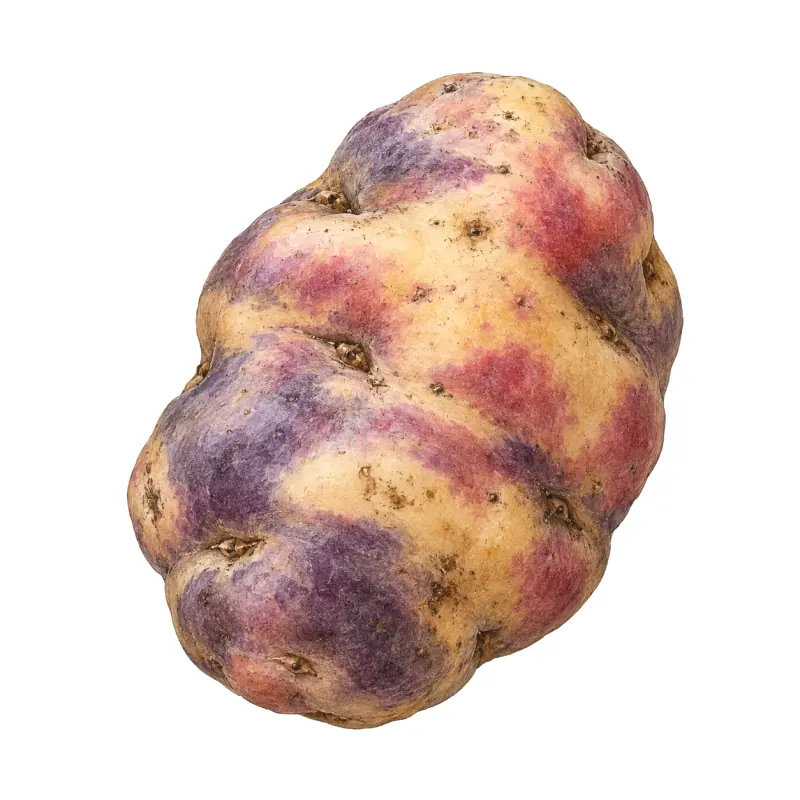
Cassava, also called manioc or yuca, is the starchy root of Manihot esculenta. Its origin was long disputed. In 1999 Kenneth Olsen and Barbara Schaal compared the DNA of cassava with its wild relatives and found that it was most likely domesticated from wild populations of M. esculenta subsp. flabellifolia along the southern border of the Amazon basin, in what are now the Brazilian states of Mato Grosso, Rondônia and Acre. It does not derive from several wild species, as had been proposed. Cassava was domesticated no more than 10,000 years ago and was widely grown across tropical America by 3,000 years ago, which makes its first cultivation hard to trace.
The root is poisonous until it is processed. FAO's 1977 manual explains that cassava contains a glucoside that releases hydrocyanic (prussic) acid, and that soaking, crushing, cutting and heating speed its breakdown. Growers have long distinguished "bitter" and "sweet" cassavas, but FAO notes that these are not separate species: toxicity varies with where the plant is grown. Cassava also spoils quickly once dug, so it is not traded fresh across borders.
Cassava crosses to Africa
Cassava reached Africa with the Atlantic trade. FAO's 1977 account says that "it is believed" cassava was introduced to the western coast of Africa in about the sixteenth century by slave merchants, and that the Portuguese later took it to their stations around the mouth of the Congo River. A 1997 study for the International Institute of Tropical Agriculture (Carter, Fresco, Jones and Fairbairn) states that the Portuguese began to introduce cassava at their coastal forts, trading posts and islands before 1600, and that Africans then spread it inland over two to three hundred years. Its cultivation increased in East Africa after 1850.
In many areas it replaced older staples. Cassava is now grown in almost all parts of tropical Africa where it will grow, and Olsen and Schaal put it among the staple foods of more than 500 million people across the tropics. In 2024 the world harvested 342 million tonnes of cassava. Nigeria grew 18 % of it, the Democratic Republic of the Congo 14 % and Ghana 8 %.
Sweet potato and the Polynesian question
Sweet potato, Ipomoea batatas, comes from tropical America; its closest wild relative is Ipomoea trifida. How it reached the islands of the Pacific is one of the most debated questions in crop history. Sweet potato was growing in eastern Polynesia, Aotearoa New Zealand and Rapa Nui before Europeans arrived, and Polynesian names for it, kumara and related words, resemble words for the plant used by Quechua speakers in north-western South America.
The "tripartite hypothesis" holds that sweet potato reached Polynesia from South America in pre-Columbian times, and that Europeans later brought two more lines along historically documented routes, from Mexico and from the Caribbean. In 2013 Roullier and colleagues tested it with herbarium specimens, including plants collected by Joseph Banks and Daniel Solander on James Cook's first voyage in 1769. Those plants belonged to the South American gene pool, as the hypothesis predicts. Ian Barber and Thomas Higham (2021) write that most scholars accept a pre-Columbian transfer across the Pacific, made through unknown contacts.
Not everyone agrees that people carried it. A phylogenetic study by Muñoz-Rodríguez and colleagues (2018) argued that sweet potato was in Polynesia before humans, so that seeds could have drifted there naturally, and questioned the case for pre-Columbian contact. We treat the question as open.
Yams of West Africa
Yams, the many species of Dioscorea, are grown across the tropics. The Guinea yam, D. rotundata, is the main yam of West Africa. A genomic study led by Scarcelli (2019) found that it was domesticated from a forest species, D. praehensilis, rather than from the savannah yam that had also been proposed. Together with the origins of African rice and pearl millet, the authors argue, this supports the area around the Niger River as a major cradle of African agriculture. The archaeological record in sub-Saharan Africa is fragmentary, so the date is not known. In West Africa, FAO notes, yams are eaten mainly as fufu, a stiff, glutinous dough. World production was 92 million tonnes in 2024.
Other yams belong to the Pacific. Barber and Higham describe Polynesian farming as built on taro grown in wet fields and Pacific yams in dry ones, crops carried east by the first settlers of the islands.
Taro and the gardens of Kuk Swamp
New Guinea invented farming for itself. At Kuk Swamp, 1,500 m up in the Western Highlands of Papua New Guinea, archaeologists led by Denham found that plants were exploited and probably cultivated on the edge of the wetland between 10,220 and 9,910 years ago. By 6,950 to 6,440 years ago people were planting on mounds, bananas were intensively cultivated, and taro (Colocasia esculenta) had been in use since the early Holocene. Ditches to drain the swamp followed by about 4,000 years ago.
UNESCO inscribed the Kuk Early Agricultural Site on the World Heritage List in 2008. It describes Kuk as an "independent technological leap" from plant gathering to agriculture around 7,000 to 6,400 years ago, based on growing bananas, taro and yam by vegetative propagation, from pieces of the plant rather than from seed, and as one of the few places with evidence of agriculture developing independently. The 116 ha site has been worked almost continuously for 7,000 years, and possibly for 10,000. Taro is still grown throughout the tropics for its starchy corms; the world harvested 18 million tonnes in 2024.
The Andean tubers
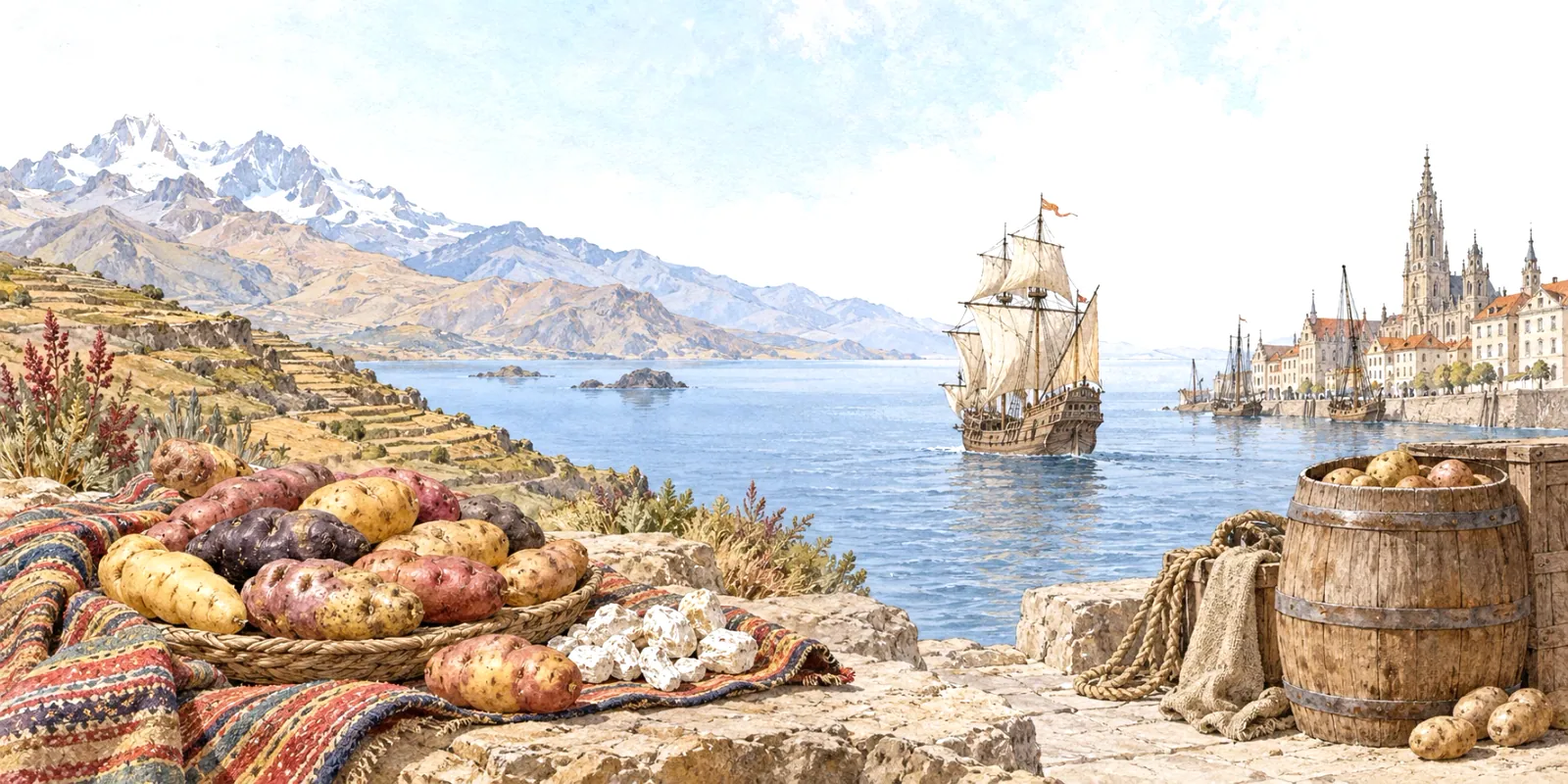
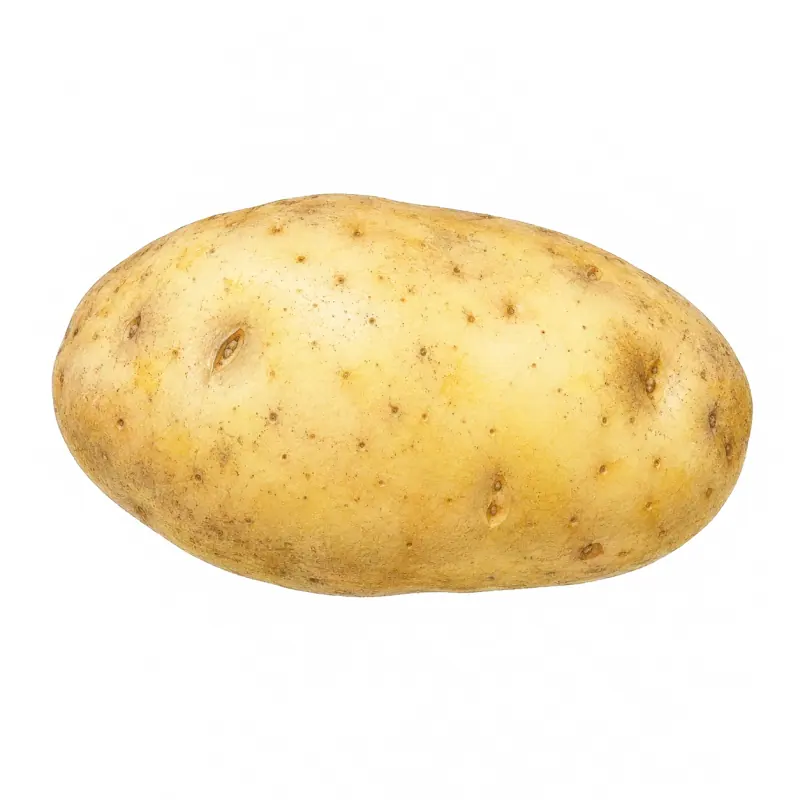
The high Andes produced more than one tuber crop. The best known is the potato, whose journey from Lake Titicaca to Europe is told in From the Andes to Europe. Around Lake Titicaca, wild tubers were a staple from at least the Middle Archaic period; potato starch has been found on grinding stones at Jiskairumoko, from the Terminal Archaic (about 5,300 to 3,500 years ago), and starch grains of potato and oca at the Early Formative site of Chiripa.
The International Potato Center (CIP) lists nine native Andean root and tuber crops. They grow from south-eastern Venezuela to north-western Argentina, with the greatest diversity in Peru, Bolivia and Ecuador, and withstand drought, frost and strong ultraviolet light. Oca (Oxalis tuberosa) is the region's second tuber after the potato. Ulluco (Ullucus tuberosus) is the most commercially successful. Mashua (Tropaeolum tuberosum) can yield up to 70 tonnes per hectare. Maca, grown above 4,000 m in Peru, is the only member of the cabbage family known to have been domesticated in the Americas. Outside the Andes these crops are little known; FAO's statistics place oca, ulluco and mashua among "roots and tubers not elsewhere specified". The potato, by contrast, became the world's leading root crop: 390 million tonnes in 2024, out of 944 million tonnes of all roots and tubers. The potato's own native landraces have their own page.
How it connects
Continue exploring
- CountryPapua New Guinea3 entries in the atlas so far
- StoryFrom the Andes to EuropeLake Titicaca, Peru
- StoryCereals: the grasses that fed the worldTurkey
- PotatoAndean native potatoes
 RecipeCausa limeñaLima, Peru
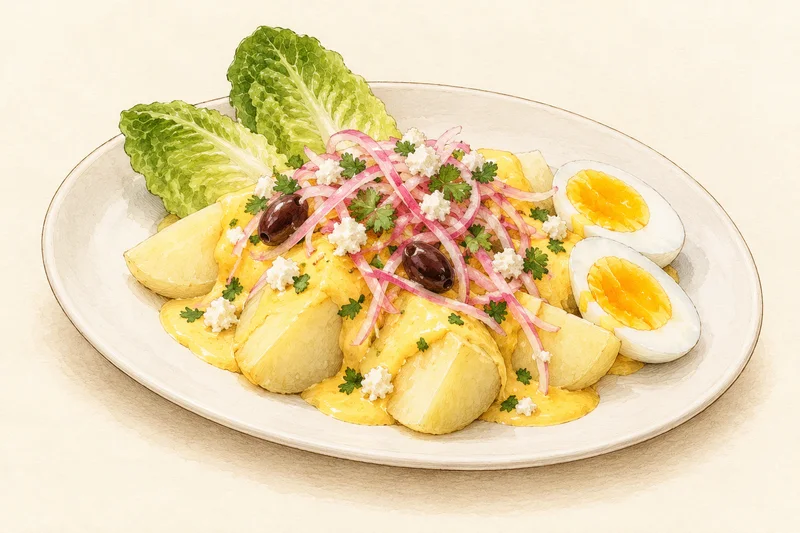 RecipePapas a la huancaínaHuancayo, Peru
 IngredientBarleyHordeum vulgare
 PotatoBintjeFriesland, Netherlands
- StyleBourbon whiskeyLegal category
 RecipeSoft polentaNorthern Italy, Italy