
Gin · Drink history · Reference page
From juniper water to London gin
Juniper was a medicine in the medieval Low Countries long before it flavoured a drink. Grain spirit with juniper became genever there in the sixteenth and seventeenth centuries. England took it up after 1688, went through the Gin Craze and the Gin Acts, and later turned gin into a cleaner, drier spirit defined today in EU law.
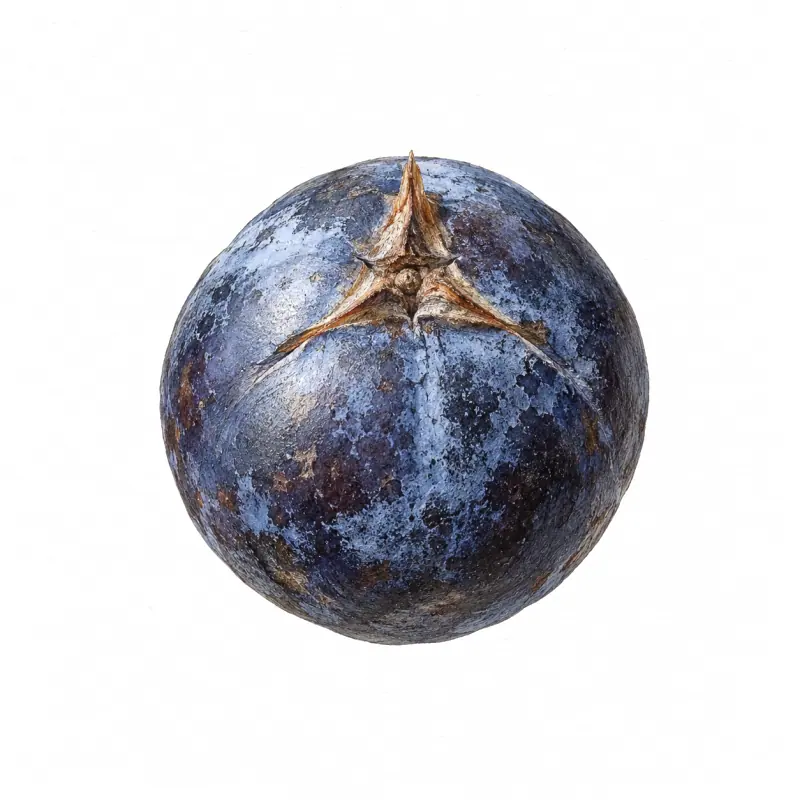
Juniper as medicine
The oldest Dutch-language evidence concerns juniper, not drink. In Der naturen bloeme, an encyclopaedia of nature written about 1266, the Flemish poet Jacob van Maerlant describes the jenewerboem, the juniper tree. Following the Salernitan author Platearius he calls it hot and dry, and recommends juniper boiled in rainwater or in wine against bodily complaints. He also explains how to draw an oil from dried juniper wood by heating it in a sealed pot. He says nothing about distilled spirit. Popular accounts that have Maerlant adding juniper to distilled wine go further than his text.
Distilled "waters" made with juniper appear later. The joint EU technical file for genever, written by the Belgian, Dutch, French and German applicants, cites a Middle Dutch text on aqua vitae copied in 1351 and Philippus Hermanni's Een constich distilleerboeck (Antwerp, 1552), which describes "the water of juniper berries" alongside the equipment for distilling. In London the distiller A. Cooper wrote in 1757 that apothecaries had once kept "a distilled spirituous Water of Juniper", until distillers took it over and sold it as a dram under the name Geneva.
Grain spirit and juniper in the Low Countries
According to the genever technical file and the Jenevermuseum in Hasselt, distillers in the Low Countries moved during the sixteenth century from wine to beer and mead, and then to fermented grain of barley, rye and malt. The grain spirit was sometimes flavoured with juniper, aniseed, caraway or fennel; juniper became the favourite. In 1601 the archdukes Albert and Isabella banned distilling from grain in the Southern Netherlands, to keep grain for bread. The ban was reissued many times and many distillers moved away, some to the Northern Netherlands.
In the seventeenth-century Dutch Republic distilling grew in Amsterdam and Rotterdam and then moved out to Weesp and to Schiedam, which became known as the genever town of the Netherlands. Schiedam's distillers ran on moutwijn, a malt-and-grain spirit, and its museum still distils it in a working branderij. Across the border, Hasselt lay in the prince-bishopric of Liège and was not bound by the 1601 ban; its production took off during a Dutch garrison of 1675 to 1681.
The Sylvius story
Many books, and even a 2024 scientific paper, say that the Leiden professor Franciscus de le Boë Sylvius invented genever around 1650 as a medicine. Sylvius was born in 1614 and taught at Leiden from 1658 until his death in 1672. Leiden University itself calls the attribution dubious: encyclopaedias only say the drink is "attributed to" him, which "cannot be seen as real proof". The Oxford Companion to Spirits and Cocktails traces the claim to Samuel Morewood's essay of 1824 and says Sylvius has "no claim" to the title. Juniper waters and grain spirits are documented in the Low Countries before he was born. The atlas treats the Sylvius story as a myth.
England after 1688
William of Orange became King of England in 1689. According to History Today, his accession cost England its imports of French brandy, and Parliament liberalised distilling to promote the new Dutch spirit. An Act of 1690 set out to promote "Brandy Strong waters and Spirits from malted Corne", for "the greater consumption of Corne and the advantage of Tillage", and allowed any person to distil who paid the duties. From 1688 duties on ale and beer rose while those on spirits stayed low.
In 1757 the London distiller A. Cooper still called the juniper spirit "Geneva". His recipe distils juniper berries with malt spirit and water; he also complains that cheap Geneva was flavoured with oil of turpentine instead of juniper, and notes that "Holland's Geneva", imported from the Dutch, was more highly regarded.
The Gin Craze and the Gin Acts
By the 1730s London had more than 1,500 distillers, and in 1726 the Middlesex justices counted at least 6,000 retailers of spirits. Warner and colleagues date the "gin epidemic" to 1720 to 1751, the first time an English government tried systematically to control the sale of alcohol. The 1729 Act imposed a £20 retail licence and was repealed in 1733. The 1736 Act set a duty of 20 shillings a gallon and a £50 licence; it provoked riots in 1737 and was repealed in 1743. The 1751 Act set licences at £2, raised duty moderately and restricted retail to rent- and rate-paying householders.
Consumption fell from 8.5 million gallons in 1751 to 2.1 million by 1760. Historians do not credit the law alone. Warner's time-series study found that each major act worked only briefly and that the 1751 Act "succeeded by accident rather than by design"; cheaper beer also played a part. William Hogarth's print Gin Lane, published with Beer Street in February 1751, gave the campaign its lasting image.
Gin palaces, Plymouth and London gin
In the 1830s London's spirit shops were rebuilt as "gin palaces", with etched plate glass, gaslights and long mahogany bars; Dickens described one near Drury Lane in 1835. In Plymouth, a merchant's house of about 1500 was remodelled as a gin distillery from 1793, the Black Friars distillery of Coates & Co.
In the Low Countries distillers took up the column still from 1829, and cheap, near-neutral spirit spread through the trade. Today's definitions of gin are legal ones. Under EU Regulation 2019/787, gin needs only juniper-led flavouring of agricultural alcohol, distilled gin must be redistilled with juniper and other botanicals, and London gin must take all its flavour from that distillation, with no colouring and almost no sugar. "London" names a method, not a place.
Decline and revival
Genever suffered in the twentieth century. During the First World War the occupying Germans took Belgian distillers' copper stills, and Belgium's Vandervelde law of 1919 banned spirits in public bars and allowed sales only by two litres at a time. In the Netherlands two recipes, oude (old) and jonge (young) genever, took shape after the Second World War; the names describe recipes, not age. In 2008 EU law protected genever as a geographical indication for Belgium, the Netherlands and parts of France and Germany.
Gin went through its own slump: a 2024 review, citing earlier work, says vodka outsold gin for the first time in 1967. The same review reports that the number of UK gin distilleries tripled to 360 between 2012 and 2019. Sipsmith, which opened in March 2009, calls itself the first new copper distillery in London since 1820; that is the brand's own claim, and the atlas has not verified any accompanying change in licensing rules.
How it connects
Style
- related Genever
- related London gin (London dry gin)
Ingredient
- related Juniper
Region
- related Netherlands
- related Schiedam
- related London
History
- related Gin Act of 1736
- related Gin Act of 1751
- related Hogarth's Gin Lane (1751)
Story
- related A history of whisky
Continue exploring
- CountryNetherlands19 entries in the atlas so far
- StoryA history of whiskyScotland, United Kingdom
- IngredientJuniperJuniperus communis L. (EU law also allows J. oxycedrus for juniper-flavoured spirit drinks and genever)
- RegionNetherlandsNetherlands
- StyleGeneverProtected name
- StyleLondon gin (London dry gin)Legal category
- HistoryGin Act of 17361736
- HistoryGin Act of 175125 June 1751
- HistoryHogarth's Gin Lane (1751)1 February 1751
- RegionLondonLondon, United Kingdom