Explore the world · Recipe · Osaka · Reference page
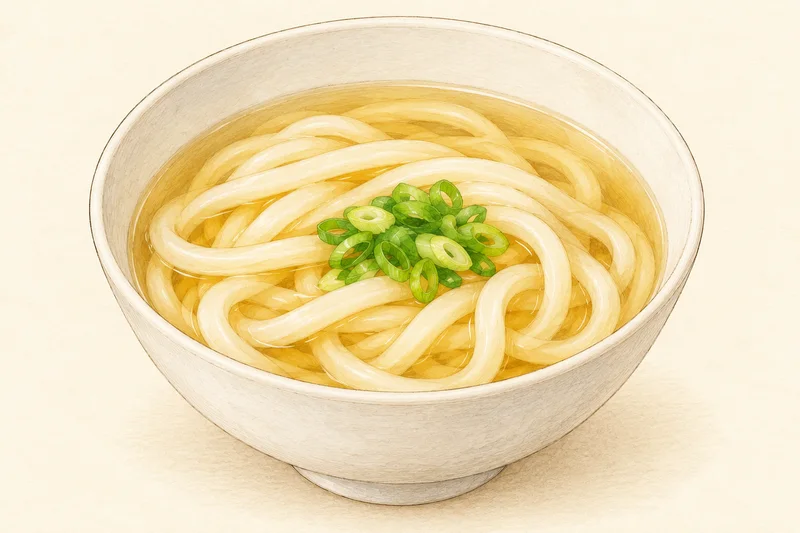
Kake udon
かけうどん (kake udon)
Thick wheat noodles in a hot, light dashi of kombu and bonito seasoned with light soy sauce, mirin and sake, topped with sliced green onion. The broth and quantities follow the Osaka udon recipe published by Japan's Ministry of Agriculture; kake udon is the bowl without the sweet fried tofu that makes it kitsune.
- Servings
- 2
- Preparation
- 5 min
- Cooking
- 15 min
- Resting
- 40 min
- Total
- 1 h
- Difficulty
- Easy
Equipment
- Saucepan; sieve or cloth for straining the dashi
- Large pot of boiling water for the udon
Ingredients
Dashi
Seasoning (for 600 ml dashi)
Bowls
Method
Put the water and kombu in a pan and leave for 40 minutes.
Why Soaking draws the kombu's glutamate into the water before any heat.
Timer · 40 min40:00Heat it. When it starts to boil, add the bonito flakes, simmer 2–3 minutes and strain through a sieve or cloth.
Timer · 3 min3:00Season 600 ml of this dashi with the sugar, salt, mirin and sake, then adjust with light soy sauce to taste. Keep it hot.
Boil the udon, drain well and put into warmed bowls.
Pour over the hot broth and top with green onion, and kamaboko and yuzu if using.
To drink & serve with
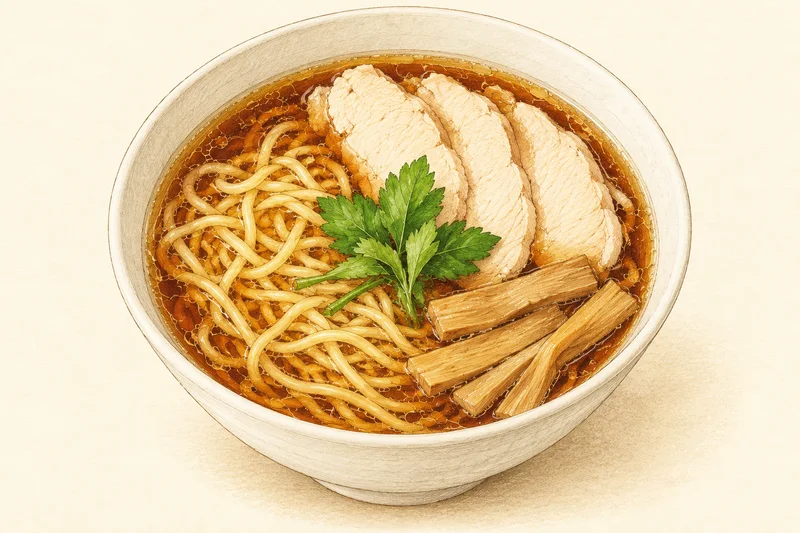
- Shoyu ramen
A darker, richer Japanese noodle bowl for comparison.
Substitutions
- Kombu and bonito dashi → In Kagawa (Sanuki udon) the broth is built on iriko, small dried sardines or anchovies, as the Umami Information Center describes.
- Plain kake → Kitsune udon: simmer 2 sheets of blanched fried tofu (aburaage) for 3 minutes in a second dashi (the used kombu and bonito with 400 ml water) seasoned with 10 g sugar, a pinch of salt and 1 tbsp light soy, and lay them on top.
Common mistakes
- Simmering the bonito flakes longer than the 2–3 minutes the recipe gives.
- Using dark soy sauce: the Osaka broth stays light in colour.
Storage & reheating
Cool the dashi within 2 hours; it keeps 2 days in the fridge. Cook the noodles only when serving.
Safety
Contains gluten (udon, soy sauce), soy and fish (bonito, kamaboko).
Allergens
Gluten · Fish · Soy
Check labels: stock, bacon and sauces can contain further allergens.
Dietary
pescatarian
Osaka broth, Kagawa noodles
Kake is the plainest udon: warm noodles in warm broth. Japan's Ministry of Agriculture describes how Osaka, a trading city where kombu from Hokkaido, wheat and salt converged, developed a broth culture from the mid-Edo period, with udon and soba shops recorded near Osaka Castle under Toyotomi Hideyoshi. Its kitsune udon, the same bowl topped with sweet fried tofu, is said to have begun in 1893 at the shop Matsubaya in Funamachi.
Across the Inland Sea, Kagawa (old Sanuki) eats more udon than any other prefecture, according to the Umami Information Center: a dry, warm climate for wheat, local salt and soy sauce, and dried sardines for the broth.
Soak, flash-simmer, season lightly
The MAFF recipe, by Usamitei Matsubaya under the Japan Konamon Association, soaks kombu for forty minutes, adds bonito flakes at the boil for only two or three minutes and strains. Sugar, salt, mirin and sake round the dashi, and light (usukuchi) soy sauce seasons it without darkening it, so the noodles show through the broth.
How it connects
Place
- origin Osaka In preparation
Recipe
- related Iya soba
- related Shoyu ramen