Explore the world · Recipe · South Korea · Reference page
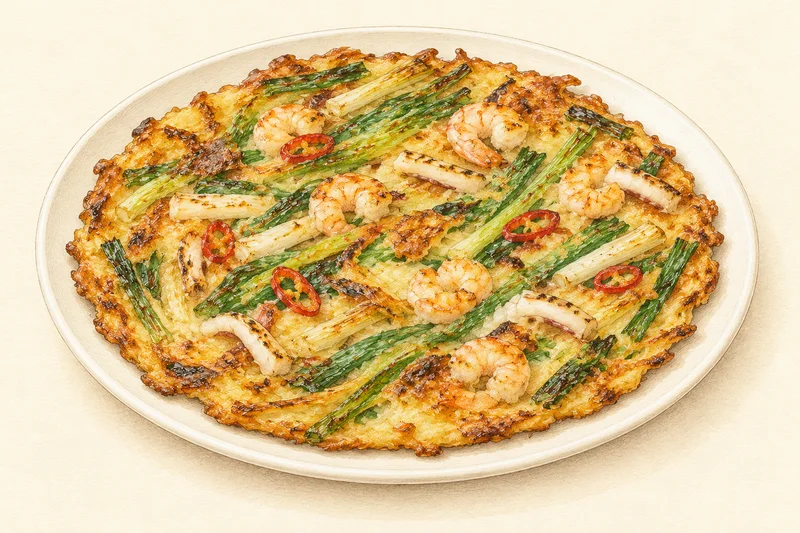
Korean seafood and scallion pancake (haemul pajeon)
해물파전 (haemul pajeon)
A thin, crisp pancake of whole scallions and mixed seafood set in a light batter and fried in plenty of oil, served hot with a soy and vinegar dip. Hyosun Ro's recipe from Korean Bapsang; in Korea it goes with makgeolli, especially on rainy days.
- Servings
- 4
- Preparation
- 10 min
- Cooking
- 20 min
- Total
- 30 min
- Difficulty
- Moderate
Equipment
- Large non-stick frying pan
- Wide spatula
- Mixing bowl
Ingredients
The pancakes
Dipping sauce
Method
Drain the seafood, scallions and chilli well. Cut the scallions in half crosswise and split thick white parts lengthwise. Mix the seafood with the sesame oil. Mix the dipping sauce.
Why Wet ingredients make the pancake soggy.
Mix the pancake mix with the icy water, adding a spoonful more at a time if needed: the batter should be thinner than a breakfast-pancake batter and thicker than crêpe batter. Stir in half the seafood.
Why A thin, cold batter fries crisp.
Heat 3–4 tbsp oil in the pan over a medium-high heat. Ladle in half the batter and spread it into a thin round.
Lay half the scallions on top in a single layer, pressing them in, then half the remaining seafood and some chilli. Spoon over half the beaten egg.
Fry until the underside is golden, 3–4 minutes, lowering the heat if it browns too fast. Turn it over, add 2–3 tbsp oil round the edge and fry 3–4 minutes more. Repeat with the rest and serve hot with the dip.
Timer · 8 min8:00
To drink & serve with
Hyosun Ro: in Korea haemul pajeon is often paired with makgeolli, milky rice wine.
Substitutions
- Buchim garu → Hyosun Ro's home mix: ¾ cup plain flour, 2 tbsp rice flour, 2 tbsp potato or corn starch, 1 tsp minced garlic or garlic powder, ½ tsp salt. Half pancake mix and half frying mix (twigim garu) is crispier.
- Mixed seafood → Any one or two kinds; a bag of frozen seafood mix works if thawed and drained.
Common mistakes
- Wet seafood or scallions: the pancake turns gummy.
- Too little oil: the pancake will not crisp.
- A thick batter: it becomes bready.
Storage & reheating
Best straight from the pan. Refrigerate leftovers within 2 hours and eat within a day, recrisped in a hot pan.
Safety
Contains gluten, crustaceans, molluscs, egg, sesame and soy. Cook until the seafood is opaque; the batter must be cooked through. Thaw frozen seafood in the fridge (US FDA).
Allergens
Gluten · Crustaceans · Molluscs · Egg · Sesame · Soy
Check labels: stock, bacon and sauces can contain further allergens.
Dietary
dairy-free
Jeon for a rainy day
Hyosun Ro of Korean Bapsang writes that in Korea haemul pajeon is often paired with makgeolli, milky rice wine, and that Koreans say: when it rains, stay home and eat jeon, savoury pancakes, of which pajeon is a favourite. Home cooks keep a bag of commercial pancake mix (buchim garu) in the pantry, a seasoned blend of wheat flour, starch, rice flour and sometimes baking powder.
SBS Food describes the dish as originating in the port city of Busan, where it is eaten warm as a snack; that origin is tradition rather than documented history.
Cold batter, hot oil
Everything in Ro's method aims at crispness: thin scallions, seafood drained dry, batter mixed with icy water to a consistency between pancake and crêpe batter, and a generous amount of oil, topped up when the pancake is turned. The scallions are pressed in as a layer on top of a thin round of batter rather than mixed through.
How it connects
Place
- origin South Korea In preparation