Explore the world · Recipe · Genoa · Reference page
Focaccia genovese (fügassa)
fügassa
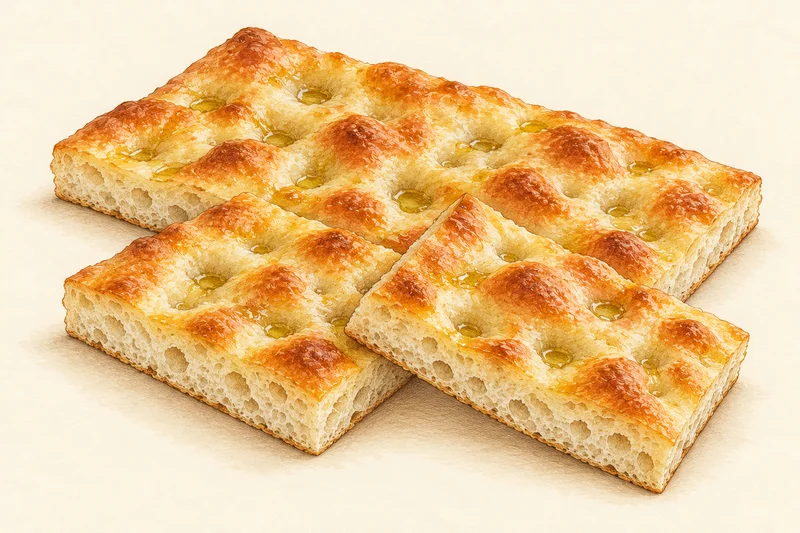
Genoa's flat, oily bread: a soft dough pressed into an oiled tray, dimpled with three fingers and flooded with olive oil and salted water before baking, so the hollows stay moist and the top turns golden. This is GialloZafferano's recipe by Ezio Rocchi, for two 30 × 40 cm trays.
- Servings
- 8
- Preparation
- 30 min
- Cooking
- 15 min
- Resting
- 3 h 20
- Total
- 4 h 5
- Difficulty
- Moderate
Equipment
- Two 30 × 40 cm baking trays
- Dough scraper
Ingredients
Dough
Trays and topping
Brine (salamoia)
Method
Mix the two flours in a bowl, make a well and pour in almost all the water. Mix, then add the malt and salt together.
Add the rest of the water and mix until even. Once the salt is in, crumble in the yeast and mix a little more.
Knead vigorously on the bench, flouring only if very sticky. When the dough is nearly elastic, add the 30 g of oil and keep kneading until it is absorbed and the dough is smooth, 13–15 minutes in all. Rest a few minutes.
Timer · 15 min15:00Divide into two 500 g pieces. Flatten each into a rectangle, fold in three, roll up with the seam underneath and dust with flour. Cover and rest 30 minutes.
Timer · 30 min30:00Oil a tray with 15 g of oil. Press one piece out with three fingers, roll it into a rectangle and lift it onto the tray so it covers 70–80 % of it. Cover and rest 20–30 minutes. Repeat with the second piece.
Timer · 25 min25:00Dust with a little flour and press the dough out to the edges with your fingertips, starting at the rim so it sticks to the tray. Smooth with your palms. Cover and rest 1 hour.
Timer · 1 h60:00Dissolve the 10 g of salt in 200 g of water.
Dust lightly with flour and press dimples all over with three fingers held at an angle, about 1 cm apart. Pour 30 g of oil and 90 g of brine into the centre of each focaccia and spread it so it fills the holes.
Why The brine and oil pool in the dimples; that wet surface is what makes a Genoese focaccia different from a dry bread.
Leave to rise uncovered for 40–45 minutes.
Timer · 45 min45:00Bake in a static oven preheated to 230 °C for 15 minutes, until golden. Cool a few minutes before cutting.
Timer · 15 min15:00
Substitutions
- Malt → The same weight of brown sugar (the source's alternative).
- Mixed flours → Any flour of about W 280–300 on its own; the source says to adjust the mix to that strength.
Common mistakes
- Baking in a dark, thick tray at too low a heat: the base stays pale and the top dries before it colours.
- Pressing the dimples straight down through the dough: the source angles the fingers so the holes stay closed underneath.
Storage & reheating
Best the day it is baked; keep in a paper bag for up to a day. Baked focaccia can be frozen; the raw dough should not be.
Allergens
Gluten
Check labels: stock, bacon and sauces can contain further allergens.
Dietary
vegan
A family of Ligurian focacce
In Genoa this bread is fügassa. It belongs to a family of Ligurian focacce, one of which has an EU protected name: the Focaccia di Recco col formaggio, two sheets of oiled dough stretched by hand to under a millimetre with fresh cheese between them, baked at 270–320 °C for 4–8 minutes. Its specification cites a reference of 1875 in L. T. Belgrano's Vita privata dei genovesi. The plain Genoese focaccia has no such specification.
Oil, brine and three fingers
The dough is soft but strong (Rocchi blends 00 and Manitoba flours for a strength of about W 280–300) and is spread into the tray in stages, with rests, so it does not spring back. The decisive step comes just before the last rise: angled dimples, then 30 g of oil and 90 g of salt water per tray poured into them. The surface bakes golden while the dimples steam in their brine.
How it connects
Place
- origin Genoa In preparation
Recipe
- related Ciabatta