
Meat · Recipe · Alsace · Reference page
Choucroute garnie
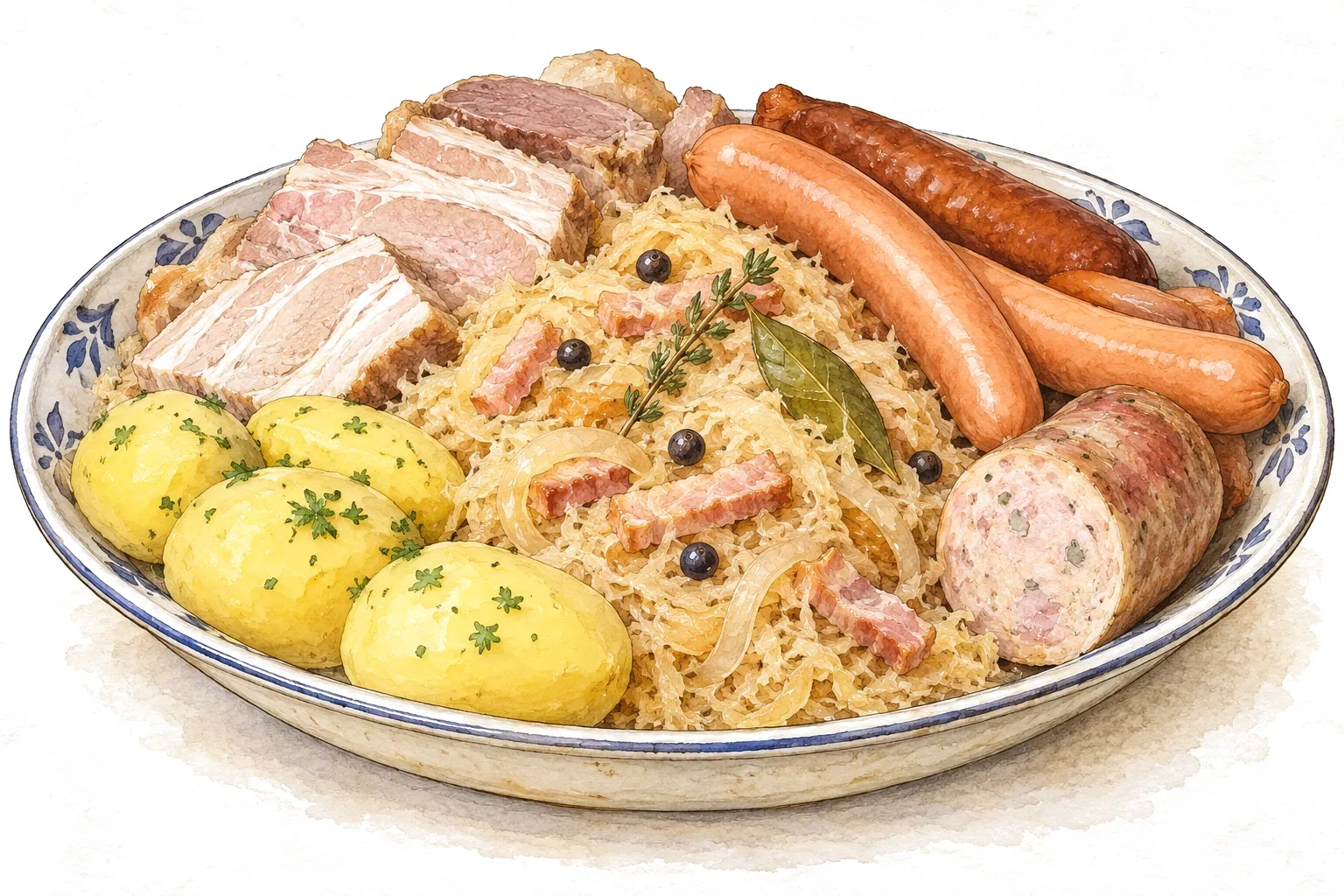
Sauerkraut braised in dry Alsace white wine with bacon, onion and juniper, and served with lightly salted pork, smoked and Strasbourg sausages and boiled potatoes. Choucroute d'Alsace has been a protected geographical indication since 2018.
- Servings
- 8
- Preparation
- 40 min
- Cooking
- 1 h 30
- Resting
- 30 min
- Total
- 2 h 40
- Difficulty
- Moderate
Equipment
- Large pot for the pork (about 6 litres)
- Large cast-iron casserole with lid for the sauerkraut (about 6 litres)
- Saucepan for the potatoes
Ingredients
Pork
Sauerkraut
To serve
Method
Put the pork in the large pot, cover with cold water, add the bouquet garni and bring slowly to the boil. Skim, then simmer gently for about 1 hour 30 minutes, until tender.
Timer · 1 h 3090:00Meanwhile, loosen the sauerkraut with your fingers so there are no clumps. Taste it: if it is very sour or salty, rinse it briefly in cold water and squeeze it dry.
Why Escoffier soaks only old sauerkraut and prefers fresh, unrinsed sauerkraut: rinsing removes flavour as well as salt.
In the casserole, warm the fat and cook the bacon and onions for 5 minutes without browning. Add the sauerkraut and mix gently. Pour in the wine, add the juniper, thyme and bay, and season lightly. Bring to the boil, cover and simmer over a low heat for about 1 hour, stirring once or twice.
Why Wine and gentle heat soften the cabbage and round its acidity; juniper is the classic seasoning.
Timer · 1 h60:00About 30 minutes before serving, boil the potatoes in salted water until tender. At the same time, lay the Strasbourg sausages and garlic sausage (and the smoked sausages, unless they need longer: follow the label) on the sauerkraut, turn off the heat, cover and leave 30 minutes.
Why The sausages heat through in the steam without boiling, so their skins do not burst.
Timer · 30 min30:00Drain the pork, slice it and add it to the sauerkraut. Reheat gently, without letting the sausages boil. Serve on a large dish: sauerkraut in the middle, meats around it, potatoes alongside, with mustard.
To drink & serve with
- Alsace
A dry, well-chilled Alsace Riesling, Pinot Blanc or Sylvaner: their acidity balances the sauerkraut and the fat of the meats. Avoid sweeter wines.
Or a pale Alsace beer.
Substitutions
- Riesling → Sylvaner or Pinot Blanc, or a light Alsace beer.
- Demi-sel pork → Smoked pork loin (Kassler) or a ham hock (jarret), simmered until tender.
Common mistakes
- Rinsing good sauerkraut thoroughly: it loses its taste. Rinse only if it is very acid or salty.
- Boiling the sausages: they split and dry out.
- Salting before tasting: the pork, bacon and sauerkraut are already salty.
Storage & reheating
Choucroute reheats well. Refrigerate within 2 hours and eat within 2 days; reheat the sauerkraut until piping hot. The sauerkraut alone freezes well.
Safety
Pork must be cooked through; the long simmer ensures it. Cool leftovers within 2 hours. Allergens: sulphites (wine; sauerkraut may also contain added sulphites) and mustard. Sausages may contain milk, gluten, mustard or celery: check the labels.
Allergens
Sulphites · Mustard
Check labels: stock, bacon and sauces can contain further allergens.
Sour cabbage, protected
The word choucroute comes from the Alsatian sürkrüt, "sour cabbage". It is white cabbage, traditionally the large quintal d'Alsace, cut into fine strips, salted and left to ferment for two weeks to two months. After about 20 years of effort, Choucroute d'Alsace obtained the European protected geographical indication in summer 2018. The village of Krautergersheim, south of Strasbourg, calls itself the capital of choucroute and celebrates it every September.
Served garnie, it comes with charcuterie: Strasbourg and Montbéliard sausages, bacon, pork knuckle and potatoes. Escoffier's version braises it with goose fat or lard, carrot, onion studded with clove, juniper and blanched belly in white consommé for 4 hours, then serves it with ham, bacon and Frankfurt or Strasbourg sausages. Alsatian home recipes, such as the one followed here, braise it in white wine.
Fermentation first, then a gentle braise
In the vat, bacteria naturally present on the cabbage turn its sugars into lactic acid in the absence of air; the salt draws out water and keeps unwanted microbes in check. The result is sour, firm and pale. Cooking softens the strands and mellows the acidity. Wine adds its own acidity and aroma, fat carries the flavour of juniper and bacon, and an hour of gentle simmering is enough for raw sauerkraut; Escoffier, cooking 5 kg at a time, gives 4 hours in the oven.
The meats are cooked apart and joined at the end. Hachette simmers the salted pork in water for about an hour and a half, and lets the sausages warm through on the sauerkraut, off the heat, for 30 minutes, so they keep their snap.
How it connects
Continue exploring
- CountryFrance162 entries in the atlas so far
 RecipeBaeckeoffeAlsace, France
- StoryMeat and butchery: from the first herds to the packing houseUnited States of America
 PotatoCharlotte
- Wine regionAlsaceColmar, France
 RecipeJanssons frestelseSweden
 RecipePapas a la huancaínaHuancayo, Peru
 RecipePommes AnnaParis, France
 RecipePommes de terre à la lyonnaiseLyon, France
 RecipeRöstiSwitzerland