Meat · Breed · Short entry
Piemontese
The native cattle of Piedmont, once kept for work, milk and meat and now mainly for beef. Its double-muscled thigh, known locally as 'fassone' or 'doppia coscia', is caused by a mutation in the myostatin gene. The breed society describes the meat as very lean.
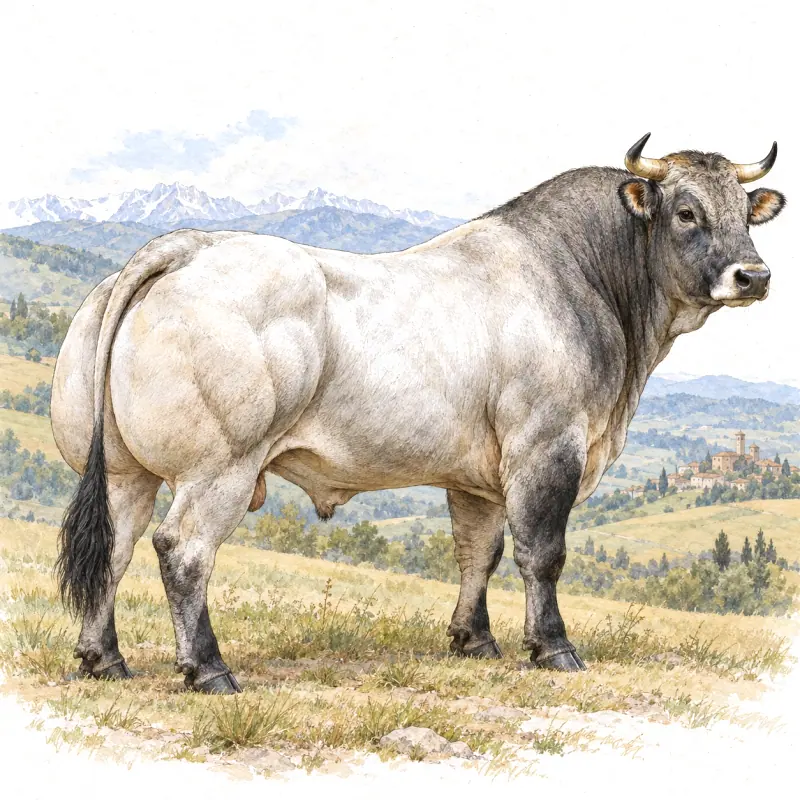
Fassone: the double-muscled thigh
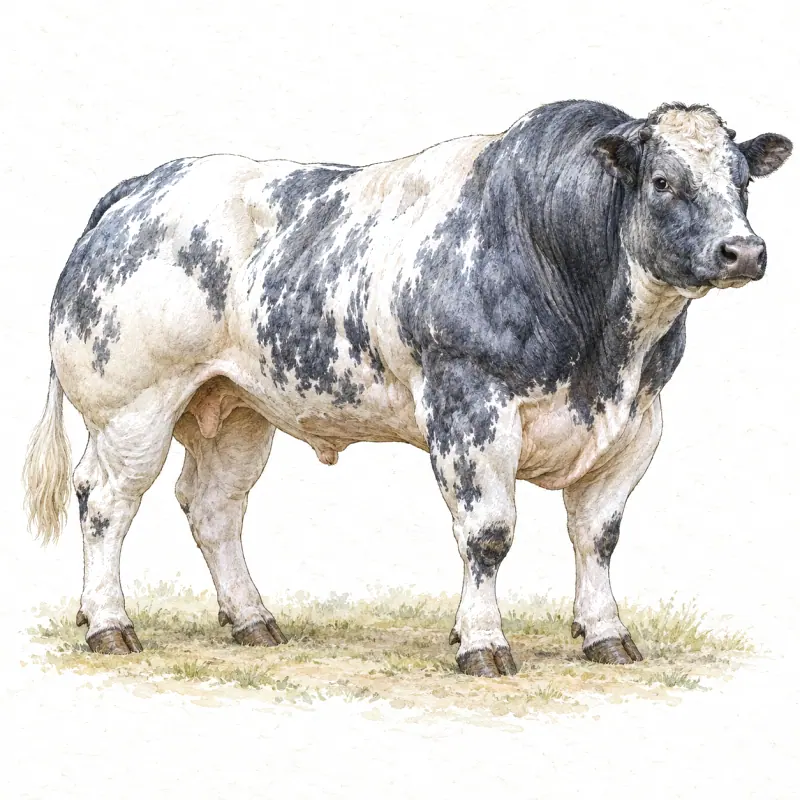
The breed society describes a marked development of the thigh muscles, called fassone or doppia coscia. In 1997 McPherron and Lee identified the cause: a missense mutation in the myostatin gene that replaces a conserved cysteine with tyrosine. In the same study they found an 11-nucleotide deletion in Belgian Blue cattle. Myostatin normally limits muscle growth, so both mutations produce the same double-muscled type.
Anaborapi says a well-finished Piemontese can dress at more than 70 % of live weight and that its meat has about half the fat of other breeds. Those are the association's figures, not independent measurements. Piemontese meat was recognised as a quality mark by ministerial decree on 1 March 1988.
Recognising a Piemontese
Calves are born dark wheaten (fromentino). Cows are white or light wheaten shading to grey. Bulls are grey or light wheaten, with black hair on the head, neck, shoulders and lower legs. The muzzle, eyelids, ear edges, tail switch and hooves are black. The horns are black until about 20 months. In adults they are yellowish at the base and black at the tip. The breed society, Anaborapi, was founded in 1960, has been based in Carrù since 1985 and has more than 4,000 member breeders.
How it connects
Breed
- similar Belgian Blue
Wine region
- related Piedmont