Meat · Breed · Short entry
Iberian pig
Cerdo ibérico
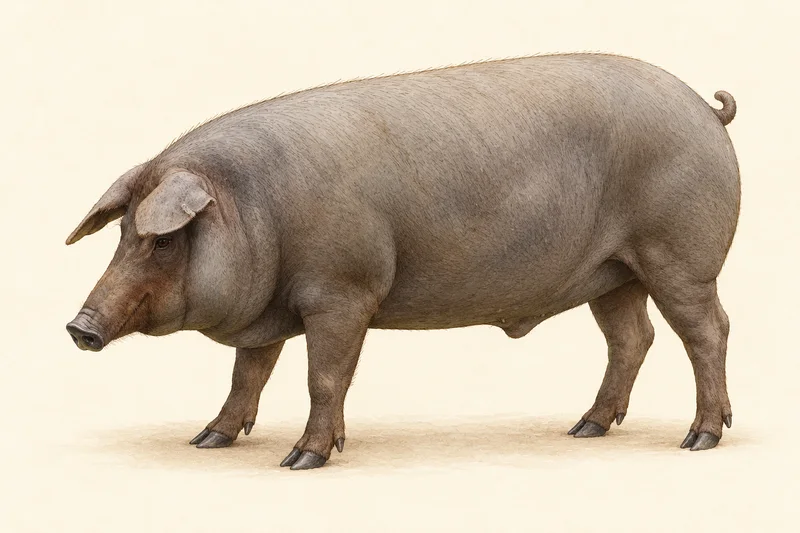
The native dark-skinned pig of the south-west of the Iberian Peninsula, traditionally fattened in the oak dehesa on acorns and grass for cured hams and loins. Its skin is always pigmented, from deep black to reddish (retinto), and its hooves are black. Spain's quality standard for Iberian ham labels each product by the share of Iberian blood and by how the pig was fed.
A breed of the dehesa
Spain's official breed catalogue describes the Iberian pig as an indigenous breed descended from the wild boar, native to Spain and Portugal, and notes references older than the Romans to hams from "the dehesas of Iberia". Isolation between local herds produced many varieties, several now lost. The breed society AECERIBER lists Retinto, Entrepelado, Torbiscal, Lampiño and Manchado de Jabugo among those that survive, and runs a conservation programme for the four that the national catalogue classes as threatened.
The breed came close to collapse in the 1970s and 1980s, which the society links to rural depopulation and indiscriminate crossing with earlier-maturing breeds. Breeders founded AECERIBER on 2 October 1985, and a ministerial order of 28 May 1987 created the herd book, which the society still keeps. Numbers have since recovered and the breed has spread beyond its traditional area. Most pigs used by the industry today are Iberian crossed with Duroc and finished intensively; pure Iberians are fattened mainly in the montanera, the autumn and winter season of acorns and pasture.
How Iberian ham is labelled
Royal Decree 4/2014 sets the Spanish quality standard for Iberian meat, ham, shoulder and loin. Products are named by the pig's feeding ("de bellota" for pigs finished on acorns, grass and other natural dehesa resources without supplementary feed, "de cebo de campo" and "de cebo") and by its breed share. "100 % ibérico" requires both parents to be pure Iberian and entered in the herd book; 75 % and 50 % products come from pure Iberian sows crossed with Duroc or Duroc-cross boars. Each ham is sealed at the abattoir with a coloured tag: black for "de bellota 100 % ibérico", red for "de bellota ibérico", green for "de cebo de campo ibérico" and white for "de cebo ibérico".
How it connects
Breed
- similar Mangalica
Continue exploring
- CountrySpain32 entries in the atlas so far
- StoryMeat and butchery: from the first herds to the packing houseUnited States of America
 BreedMangalicaHungary
 RecipeChoucroute garnieAlsace (Krautergersheim), France
- StoryCereals: the grasses that fed the worldTurkey
- StoryFish and seafood: hooks, salt, steam and farmsNorway
- StorySpices and salt: pepper, nutmeg and the taxed necessityIndonesia
 BreedBresseBresse (Ain, Jura, Saône-et-Loire), France