Explore the world · Recipe · Tokyo · Reference page
Vegetable tempura
野菜の天ぷら (yasai no tenpura)
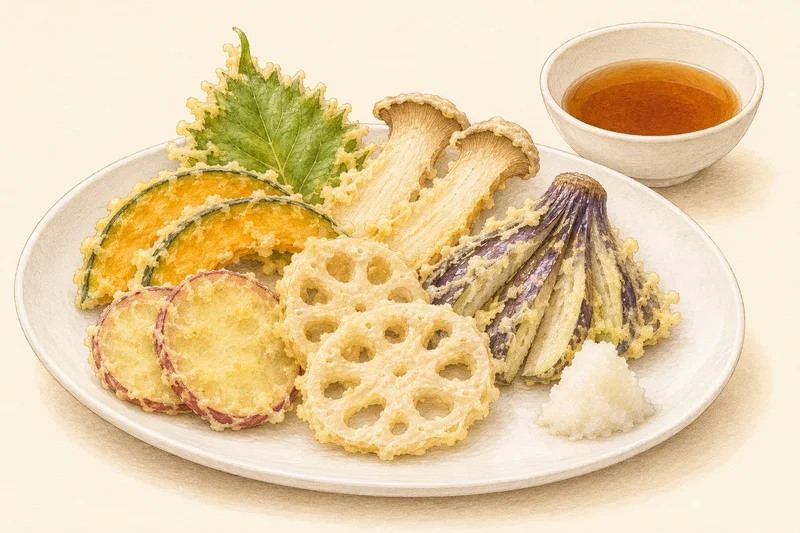
Slices of sweet potato, kabocha, lotus root, aubergine and king oyster mushroom, and whole shiso leaves, dipped in an ice-cold, barely mixed batter of flour, egg and water and fried briefly until crisp and lightly golden. Served with tentsuyu dipping sauce and grated daikon. Namiko Chen's recipe from Just One Cookbook.
- Servings
- 2
- Preparation
- 25 min
- Cooking
- 45 min
- Total
- 1 h 10
- Difficulty
- Involved
Equipment
- Deep heavy pot or deep fryer and an instant-read thermometer
- Chopsticks, a fine-mesh skimmer and a wire rack
- Large bowl for the batter set in a bowl of iced water; sieve
- Small saucepan for the dipping sauce; grater for daikon
Ingredients
Vegetables
Batter
Dipping sauce (tentsuyu)
To fry and serve
Method
Make the dipping sauce: bring the dashi, soy sauce, mirin and sugar to the boil, lower the heat until the sugar dissolves, then set aside.
Soak the sweet potato rounds in water for 15–30 minutes and the lotus root slices in vinegared water (2 cups water, 1 tsp vinegar) for 5 minutes. Slice the kabocha and the mushrooms. Pat everything completely dry.
Why Soaking removes surface starch; any moisture left on the vegetables makes the tempura soggy and the oil spit.
Just before frying, halve the aubergine lengthwise and cut each half into thin fans, leaving 2.5 cm at the stem end attached; press to fan out.
Why Cut aubergine browns and soaks up water if it waits.
Heat the oil to 160 °C.
Make the batter only now: whisk the egg into the iced water and skim off the foam. Pour it slowly into the sifted flour, mixing with chopsticks in a figure-of-eight for 15–20 seconds. Leave the lumps. Keep the bowl cold over iced water or with an ice cube.
Why Cold, barely mixed batter develops almost no gluten, so it fries light and crisp instead of bready.
Fry the sweet potato and lotus root at 160 °C for 3–4 minutes until lightly golden: dip each piece, let the excess drip for a second or two and slide it into the oil. Fill no more than half the oil's surface and skim crumbs out between batches.
Why Dense roots need a lower temperature to cook through before the batter browns. Too many pieces at once cool the oil.
Timer · 4 min4:00Raise the oil to 170–180 °C and fry the kabocha, aubergine and mushrooms for 1–2 minutes. Last, dust the back of each shiso leaf with flour, dip only that side in batter and fry for 15–20 seconds.
Timer · 2 min2:00Drain on a wire rack. Serve at once with warm dipping sauce and grated daikon to stir into it.
To drink & serve with
Editorial suggestion: with steamed rice and miso soup, or on top of soba or udon.
Substitutions
- Satsumaimo, kabocha, lotus root → Other firm vegetables cut 6 mm thick: ordinary sweet potato, pumpkin, carrot, green beans or onion rings.
- Dashi (fish-free) → Kombu dashi made with kelp only.
- Soy sauce (gluten-free) → Tamari labelled gluten-free; the batter itself contains wheat.
Common mistakes
- Overmixing the batter or letting it warm up: the coating turns heavy and greasy.
- Frying at too low a temperature for the soft vegetables: they soak up oil.
- Wet vegetables: the batter slides off and the oil splatters.
Storage & reheating
Best eaten within minutes. Leftovers can be frozen in a single layer for up to 2 weeks and re-crisped in a 200 °C oven for about 5 minutes (source). Unused dipping sauce keeps 1–2 weeks in the fridge.
Safety
Hot oil: use a deep pot no more than half full, keep children away, never leave it unattended and never put water on an oil fire. Use cultivated or shop-bought mushrooms such as king oyster; wild mushrooms only if a qualified expert has identified them with certainty, and cook them thoroughly (Anses advises at least 20 minutes for wild mushrooms). Contains gluten, egg, soy and fish (dashi is usually made with bonito).
Allergens
Gluten · Egg · Soy · Fish
Check labels: stock, bacon and sauces can contain further allergens.
From Portuguese fritter to Edo street food
Kikkoman's glossary of Japanese food traces tempura's predecessor to Nagasaki in the early Momoyama period (1568–1600), when the Portuguese brought a fritter with a thicker batter. In the 17th century a vegetable-based form fried in sesame oil, tsuke-age, appeared in Osaka. The dish reached Edo, today's Tokyo, in the An'ei era (1772–1781) and spread as a street food for ordinary people; restaurants and the modern light, crisp style came later. Kikkoman notes that tempura made only with vegetables is called shōjin-age.
Cold batter, two temperatures
Namiko Chen's batter is one volume of flour to one volume of egg and iced water, stirred for only 15–20 seconds and kept cold, with lumps left in. The vegetables are fried in two stages: dense roots such as sweet potato and lotus root at 160 °C for 3–4 minutes, softer kabocha, aubergine and mushrooms at 170–180 °C for 1–2 minutes, and shiso leaves battered on one side only for a few seconds.
How it connects
Place
- origin Tokyo In preparation