
Explore the world · Recipe · Scotland · Reference page
Scottish porridge
parritch
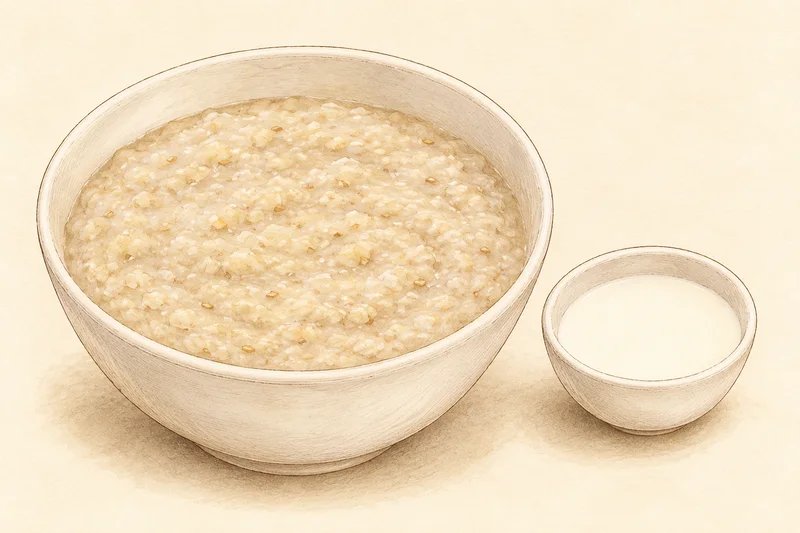
Oatmeal, water and salt, nothing else: the Scottish way, stirred with a spurtle and served in cold bowls with a separate bowl of cold milk or cream. This is F. Marian McNeill's 'one and only method' from The Scots Kitchen (1929).
- Servings
- 4
- Preparation
- 2 min
- Cooking
- 30 min
- Total
- 32 min
- Difficulty
- Easy
Equipment
- Heavy saucepan with a lid, kept for porridge if you can
- Spurtle (porridge stick) or wooden spoon
- Cold bowls, and small bowls for the milk or cream
Ingredients
To serve
Method
Bring the water to the boil.
As soon as it boils, let the oatmeal fall in a steady rain from one hand while you stir briskly with the spurtle in the other, sunwise (clockwise). Avoid lumps.
Why Adding the meal slowly to boiling water keeps every grain separate.
When the porridge is boiling steadily, lower the heat, put the lid on and cook for 20–30 minutes, according to the oatmeal.
Timer · 25 min25:00After at least 10 minutes, add the salt.
Why McNeill says salt added too early hardens the meal and stops it swelling, but porridge must never be cooked without salt.
Ladle straight into cold bowls. Serve with individual bowls of cold cream, milk or buttermilk: dip each spoonful of very hot porridge into the cold milk before eating it.
To drink & serve with
McNeill notes that porter, small beer and other drinks were once taken with porridge; today it is cold milk or cream.
Substitutions
- Medium oatmeal → Pinhead (coarsely cut) oatmeal, cooked longer, or fine oatmeal for a smoother porridge.
- Salt-only porridge → Not traditional, but honey, sugar or fruit can go on at the table (editorial).
Common mistakes
- Salting at the start: the meal stays hard.
- Pouring the oatmeal in all at once: it clumps into lumps.
- Using rolled oats: they cook in minutes and give a pasty texture, not Scottish porridge.
Storage & reheating
Best made fresh. Leftover porridge sets firm as it cools; refrigerate within 2 hours, eat within 2 days and reheat once with a little water, until steaming hot (UK FSA).
Safety
Oats are listed with the cereals containing gluten among the 14 allergens (UK FSA); oats labelled gluten-free exist. Milk or cream on the side contains milk; without it the porridge is vegan.
Allergens
Gluten · Milk
Check labels: stock, bacon and sauces can contain further allergens.
Dietary
vegan
The halesome parritch
F. Marian McNeill opened her chapter on oatmeal in The Scots Kitchen (1929) with Burns's line, "The halesome parritch, chief o' Scotia's food". Her method, which she calls "the one and only", needs three things: oatmeal, salt and water. She recommends a pot kept only for porridge, fresh spring water and good meal, and names Midlothian oats as reputed to be unsurpassed.
The stirring stick is the spurtle, called a theevil in some parts and a gruel-tree in Shetland. McNeill says to stir sunwise, "the right-hand turn for luck – and convenience". Porridge was eaten from birchwood bowls with horn spoons.
Rain of meal, late salt, cold milk
The oatmeal goes into water that is already boiling, a little at a time, while it is stirred. Once it boils steadily the pot is covered for 20 to 30 minutes. Salt goes in only after at least 10 minutes. The hot porridge is served in cold bowls, with cold milk or cream in a separate bowl; each spoonful is dipped in the milk on its way to the mouth.
McNeill also quotes a writer in The Scotsman (1962) who adds pinches of fresh meal as the porridge boils, for "a complete gamut of texture from fully boiled to almost raw meal".
How it connects
Place
- origin Scotland In preparation