Explore the world · Recipe · Lisbon · Reference page
Pastéis de nata
pastéis de nata
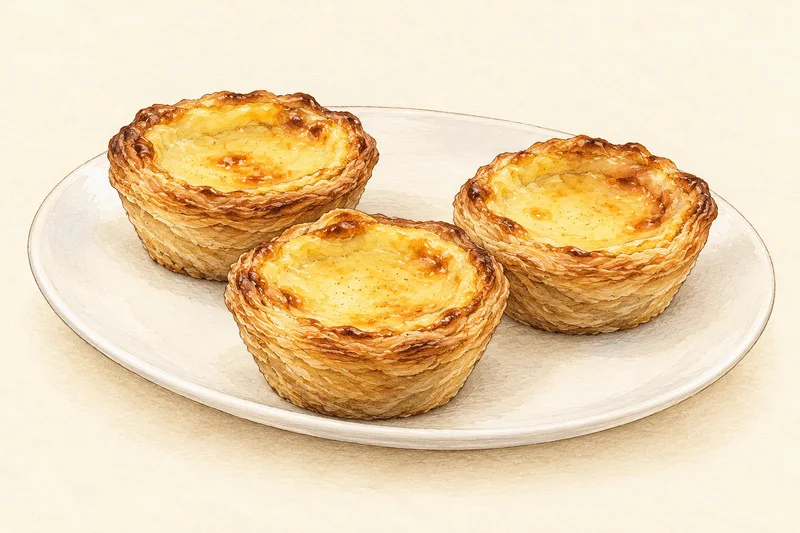
Lisbon's custard tarts: crisp, spiralled puff pastry cups filled with egg custard and baked until the top colours, finished with cinnamon. Anneka Manning's recipe uses a cooked custard instead of the traditional sugar syrup, and bought puff pastry.
- Servings
- 12
- Preparation
- 1 h
- Cooking
- 30 min
- Resting
- 1 h 35
- Total
- 3 h 5
- Difficulty
- Moderate
Equipment
- 12-hole muffin tin (80 ml holes)
- Medium saucepan and whisk
- Rolling pin; sharp knife
- Wire rack
Ingredients
Custard
Pastry
Method
Heat the oven to 210 °C (190 °C fan). Brush the muffin tin with melted butter.
In a saucepan whisk the yolks, whole egg, 100 g sugar and cornflour until smooth. Whisk in the milk gradually, then the cream.
Stir over a low heat until the custard thickens and comes to a simmer. Take off the heat and stir in the vanilla.
Why The cornflour stops the eggs curdling when the custard simmers, which makes this version more forgiving than the syrup method.
Pour into a heatproof bowl, cover the surface with cling film and refrigerate about 1 hour, stirring now and then, until it is at room temperature.
Timer · 1 h60:00Mix the 2 tbsp sugar with 1 tsp cinnamon. Sprinkle half over one pastry sheet, lay the second sheet on top, sprinkle with the rest and press together with a rolling pin.
Roll the sheets up firmly into a log and cut into 12 even slices.
Why Cut side up, the spiral of layers opens into the flaky rings typical of a nata case.
On a lightly floured bench, flatten each slice and roll it to a 10 cm circle. Press into the tin holes.
Divide the cooled custard between the cases and bake 25–30 minutes, until the pastry is crisp and the custard lightly golden on top.
Timer · 28 min28:00Leave 5 minutes in the tin, then cool on a wire rack about 30 minutes. Serve at room temperature, dusted with the remaining cinnamon if you like.
Timer · 35 min35:00
Substitutions
- Cooked custard → The traditional custard is made with a sugar syrup cooked separately and whisked into the egg and milk mixture; the source replaces it with this simpler, more stable method.
Common mistakes
- Pastry too thick at the base: roll the slices to 10 cm so the base bakes crisp.
- Hot custard in raw pastry: it starts melting the butter layers before baking. Cool it first.
Storage & reheating
Best the day they are made, at room temperature. Leftovers go soft in the fridge; re-crisp briefly in a hot oven.
Allergens
Gluten · Milk · Egg
Check labels: stock, bacon and sauces can contain further allergens.
Dietary
vegetarian
The monastery and the refinery
The most famous of these tarts are the pastéis de Belém, sold since 1837 next to the Jerónimos Monastery in Lisbon. The bakery's own history says that a sugar-cane refinery with a small shop stood beside the monastery in the early 19th century. After the liberal revolution of 1820, all convents and monasteries were closed in 1834, and someone from the monastery began selling sweet pastries in the shop. From 1837 they were baked in buildings attached to the refinery from the monastery's 'secret recipe', which, the bakery says, only its master confectioners know.
Spiral pastry, set custard
Two things make a nata: the pastry and the heat. Rolling two sheets into a log and cutting slices gives cases whose layers run in a spiral and flake outwards. Anneka Manning cooks the custard with cornflour before it goes into the cases, so it holds in a hot oven (210 °C) for 25–30 minutes while the pastry crisps and the top colours. She notes that traditional custards are made with a sugar syrup instead.
How it connects
Place
- origin Lisbon In preparation
- in Portugal In preparation