Explore the world · Recipe · Brussels · Reference page
Brussels waffles
gaufre de Bruxelles / Brusselse wafel
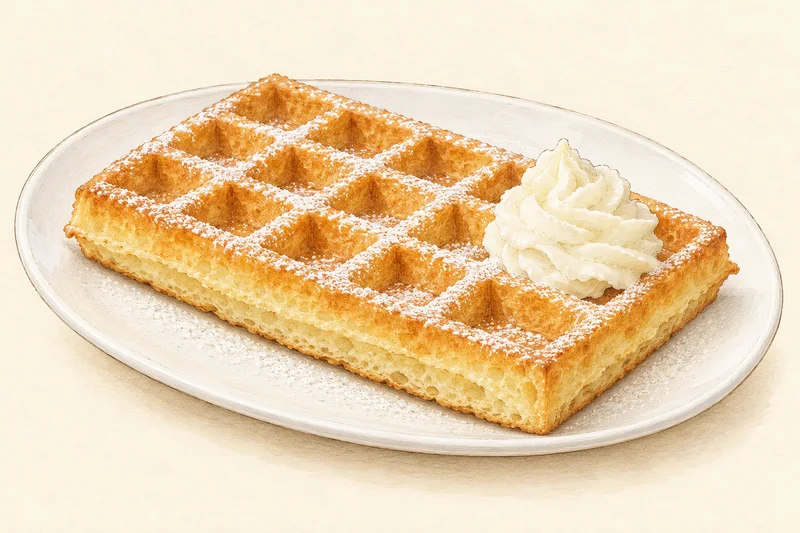
Light, crisp rectangular waffles with deep square cells, made from a yeasted batter lightened with whisked egg whites and served with icing sugar and whipped cream. Jeroen Meus's recipe, for at least twelve.
- Servings
- 4
- Preparation
- 25 min
- Cooking
- 30 min
- Resting
- 20 min
- Total
- 1 h 15
- Difficulty
- Easy
Equipment
- Brussels waffle iron (deep rectangular cells)
- Two large bowls, whisk and spatula
- Piping bag with a star nozzle (for the cream)
Ingredients
Batter (at least 12 waffles)
To serve
Method
Separate the eggs: yolks into the batter bowl, whites into a clean, grease-free bowl.
Whisk the yolks, then whisk in the milk and the yeast until the yeast dissolves. Add the lukewarm water.
Sift in the flour and whisk until there are no lumps. Melt the butter gently and whisk it in.
Whisk the whites to a firm foam and fold them in carefully to keep the air. Fold in a pinch of salt.
Why The whites make the waffles light and crisp; yeast adds flavour and lift.
Leave the batter 20 minutes in a warm, draught-free place.
Timer · 20 min20:00Whip the cream with vanilla sugar to taste and put it in a piping bag in the fridge.
Heat the iron on its highest setting and let it heat thoroughly. Ladle in batter, close at once and bake each waffle until airy and golden brown.
Timer · 3 min3:00Serve straight from the iron with icing sugar and cream.
Substitutions
- Self-raising flour → Plain flour; the yeast and egg whites still raise it.
- Yeast → The first printed recipe (Cauderlier, 1874) uses no yeast at all, only whisked whites.
Common mistakes
- An iron not hot enough: the waffle steams and stays soft.
- Stirring hard after adding the whites: the batter loses its air.
Storage & reheating
Best straight from the iron. Cooled waffles re-crisp in a hot oven or toaster; batter does not keep well once the whites are in.
Allergens
Gluten · Milk · Egg
Check labels: stock, bacon and sauces can contain further allergens.
Dietary
vegetarian
A name from 1842, a recipe from 1874
Belgium's foreign ministry, in its Focus on Belgium series, notes that waffles appear in 16th- and 17th-century paintings, but not the Brussels waffle as it is known today. The earliest known use of the name is about 1842–1843, on a porcelain card printed for a bakery in Ghent by Florian Dacher, who had worked in Brussels: Grosses Gaufres de Bruxelles. The first recipe is in the Ghent cook Philippe Cauderlier's La pâtisserie et les confitures (1874): butter, milk, flour, salt, yolks and whisked whites, no yeast and little or no sugar. By tradition, Maximilien Consael introduced the waffles, with yeast, at his fairground stall 'Max' in 1856.
Yeast and egg whites
The modern Brussels waffle has 15 or 20 deep square cells and is about 3 cm thick. Meus combines both traditions: a thin batter raised with yeast, rested 20 minutes, with whisked egg whites folded in for lightness. A very hot iron sets the outside crisp before the inside dries.
How it connects
Place
- origin Brussels In preparation
Recipe
- related Gaufre de Liège