Explore the world · Recipe · Kraków · Reference page
Bagels
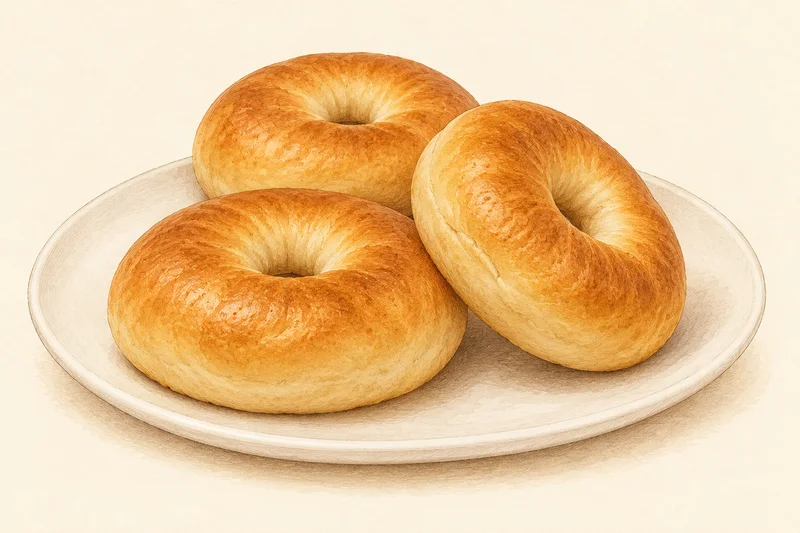
Ring-shaped rolls of firm, plain yeast dough, simmered briefly in water before baking, which gives them a shiny, chewy crust. A food of Polish Jewish bakers that became a New York staple. Rachel Allen's version simmers them in water sweetened with black treacle.
- Servings
- 7
- Preparation
- 40 min
- Cooking
- 35 min
- Resting
- 2 h 20
- Total
- 3 h 35
- Difficulty
- Moderate
Equipment
- Large bowl
- Large saucepan with a lid; slotted spoon
- Two baking trays
- Wire rack
Ingredients
Dough
Poaching and finishing
Method
Sift the flour and salt into a bowl and mix in the yeast. Stir the honey and oil into the warm water.
Make a well and pour in the liquid gradually, bringing the dough together with your hands.
Knead on a floured surface for about 10 minutes, until firm and elastic, adding flour if it sticks.
Timer · 10 min10:00Put in an oiled bowl, turn to coat, cover and leave in a warm place for 1–3 hours, until doubled.
Timer · 2 h120:00Bring a large pan of water to the boil, stir in the treacle, cover and turn off the heat. Oil two trays and sprinkle with polenta.
Knock back the dough, knead briefly, roll into a sausage and cut into 7 equal pieces. Roll each into a long, slender rope, bring the ends together, wet them and press to seal.
Lay on the trays, cover and prove 10–20 minutes. Heat the oven to 220 °C.
Timer · 15 min15:00Bring the treacle water back to a gentle simmer. Poach the bagels no more than three at a time, 1–2 minutes a side, and drain.
Why The hot water sets the outside before baking, so the bagel cannot rise much in the oven: the crumb stays dense and the crust shiny and chewy.
Timer · 4 min4:00Space them well apart on the trays, brush with egg and sprinkle with seeds or salt. Bake 15 minutes until golden, then turn them over and bake 10 minutes more to cook the bases.
Timer · 25 min25:00Cool on a wire rack.
Substitutions
- Black treacle or molasses → Honey or malt syrup in the water; the colour and the faint bitter note will be lighter.
- Fast-action yeast → Matt Tebbutt's BBC version uses 14 g dried yeast with 465 g flour and 270 ml water, and poaches in sugared water for 30 seconds to 1 minute a side.
Common mistakes
- Crowding the pan: the bagels stick together and the water drops off the simmer.
- Over-proving after shaping: they deflate in the water.
Storage & reheating
Best on the day. Keep a day in a paper bag; slice and freeze for longer and toast from frozen.
Allergens
Gluten · Egg
Check labels: stock, bacon and sauces can contain further allergens.
Dietary
vegetarian
From Kraków to New York
The first known written mention of bagels is a Yiddish regulation of the Jewish Council of Kraków in 1610, which tried to stop families spending too much on the celebration after a boy's circumcision; bagels were among the foods expected at such a feast. Polish Jewish bakers boiled their rings before baking them. The name is usually traced to the Yiddish beigen, to bend. A rival story makes the bagel a stirrup-shaped roll baked in Vienna in 1683 for the Polish king Jan Sobieski, but that is told as legend. Jewish immigrants from Poland brought bagel baking to New York, where the city's bagel bakers were organised enough to strike in 1951.
Boil, then bake
The dough is stiff and plain, with only honey for sweetness. After a short second rise the rings go into simmering water sweetened with black treacle for 1–2 minutes a side. Baking at 220 °C, turned halfway, colours the glossy, set crust without letting the bagel puff into a bread roll.
How it connects
Place
- origin Kraków In preparation