Meat · Breed · Short entry
Salers
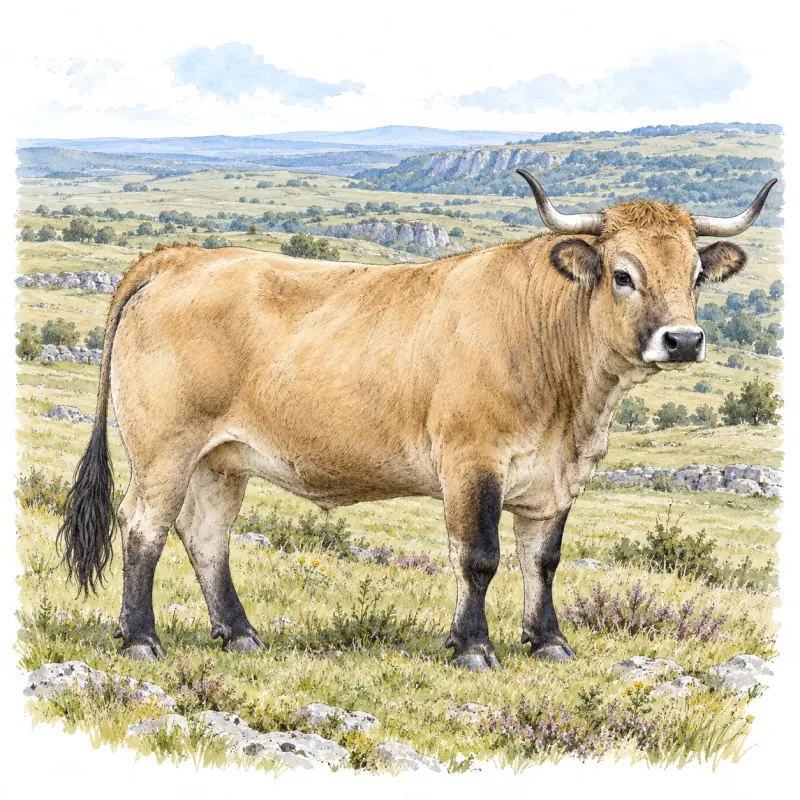
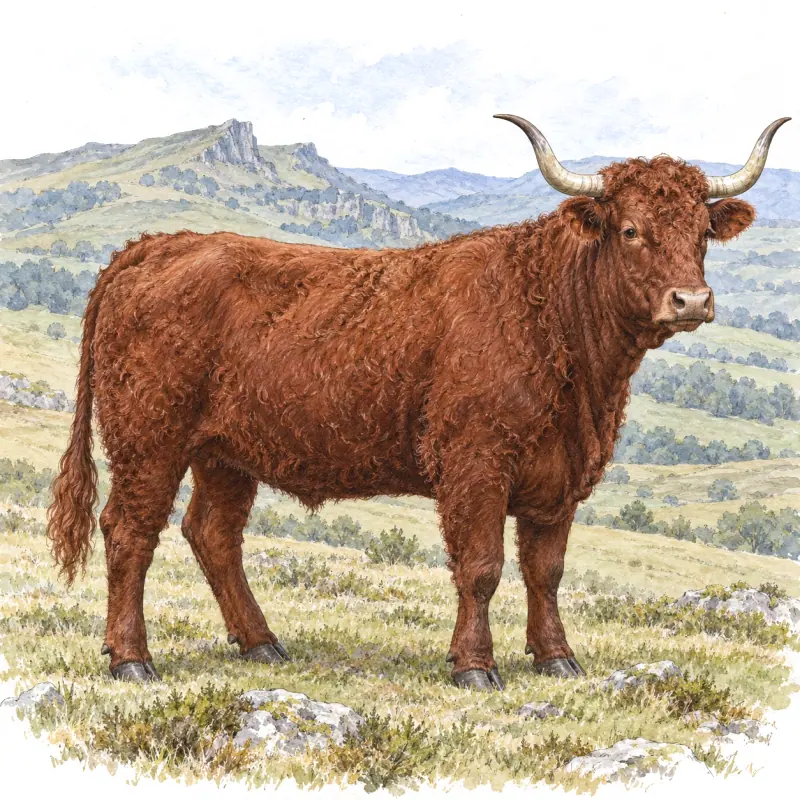
A hardy mahogany-red breed from the Massif Central, named after the village of Salers in the Cantal. It has a long, curly coat and lyre-shaped horns. Historically kept for cheese and draught, it is now mostly a suckler beef breed known for easy calving; the breed society counts about 200,000 cows in France.
Tyssandier d'Escous and the 1853 show
The breed society calls the origin of the Salers "ancient and still uncertain". Two hypotheses link it either to the Iberian Peninsula or to Britain, but neither is settled. Its documented history begins with Tyssandier d'Escous, regarded as the founder of the breed in the 1850s. He opposed crossing with other breeds and selected the best animals within the population. He held the first departmental show of the breed on 17 August 1853 in the village of Salers, and under his influence the name "race Salers" replaced "race auvergnate".
The Salers was long a cheese and draught animal. In the traditional system the calf started each milking, which took labour, and from the 1960s the system declined along with local cheese-making. The breed survived mainly by selling weaned calves (broutards), most of them to Italy and Spain. Interbev now puts the population at about 90 % suckler herds and 10 % partly milked.
Recognising a Salers
The coat is a solid mahogany red, with long, curly hair that helps the animal stand the cold. The hooves are black and the horns are lyre-shaped. The breed society reports that 99 % of calvings are easy, citing the breed's wide pelvic opening, and a calving interval of 377 days. Pure-bred males gain 1,000 to 1,100 g a day; finished young bulls weigh 600 to 700 kg live at 18 to 24 months.
How it connects
Breed
- similar Aubrac