
Meat · Breed · Short entry
Piétrain
A heavily muscled Belgian pig named after the village of Piétrain near Jodoigne in Brabant, where it appeared after the First World War. It is white with irregular black spots, has exceptional hams and the highest slaughter yield of known breeds, but the classic line carries the halothane stress gene. It spread from the 1950s, when Belgian buyers began paying more for lean pigs.
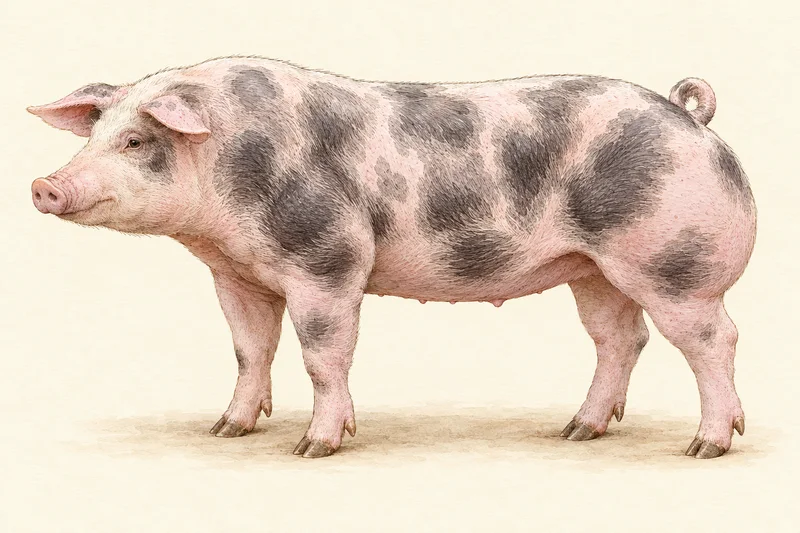
A pig for a market that paid for lean meat
A 2002 paper from the University of Liège says the breed takes its name from the commune of Piétrain, a few kilometres from Jodoigne in Brabant, where it arose after the First World War. From 1920 to 1950 it spread little, because quality did not earn a better price. Around 1950 a crisis in the pig market widened price differences by quality and raised demand for lean pigs, and only then did the Piétrain draw attention. Hanset and Van Snick (1972) also note the lack of precise information about its origin, and say selection was organised first in its home province of Brabant and later in the rest of Belgium.
The same Liège paper credits the classic Piétrain with the highest slaughter yield of all known breeds (83 %), muscular shoulders, a developed loin and exceptional hams. It also has a fixed gene for stress sensitivity at the halothane locus, linked to porcine stress syndrome, malignant hyperthermia and pale, soft, exudative meat. The fault lies in the ryanodine receptor gene. At the experimental station of the Liège veterinary faculty, breeders introduced the normal allele from the Large White by repeated backcrossing to create a stress-negative Piétrain.