Meat · Breed · Short entry
Parthenaise
A fawn-coated beef breed from west-central France, named after Parthenay in the Gâtine. Once the butter cow of the Charentes, it fell below 8,000 cows in 1980 and was rebuilt as a suckler beef breed. Its meat is bright red and fine-grained.
From Charentes butter to beef
In the mid-nineteenth century Eugène Gayot named the breed after Parthenay, using the name for the fawn-coated cattle of western France between the Loire and the Gironde. In 1892 it numbered more than a million head, the third breed of France, and its herd book was opened in 1893. After phylloxera ruined the Cognac vineyards, many farmers turned to dairying with Parthenaise cows and built the reputation of Charentes butter.
Vineyard replanting, mechanisation, specialised dairy breeds and crossbreeding then caused a steep fall. By 1965 only 12 breeders still registered animals, and in 1980 the breed reached its low of between about 7,500 and 7,850 cows. A selection body (UPRA) was created in 1983 and the breed was redirected to suckler beef, ending milking and ox rearing. In 2022 about 56,000 cows were recorded in the national database, about 17,000 of them registered with the breed society.
Recognising a Parthenaise
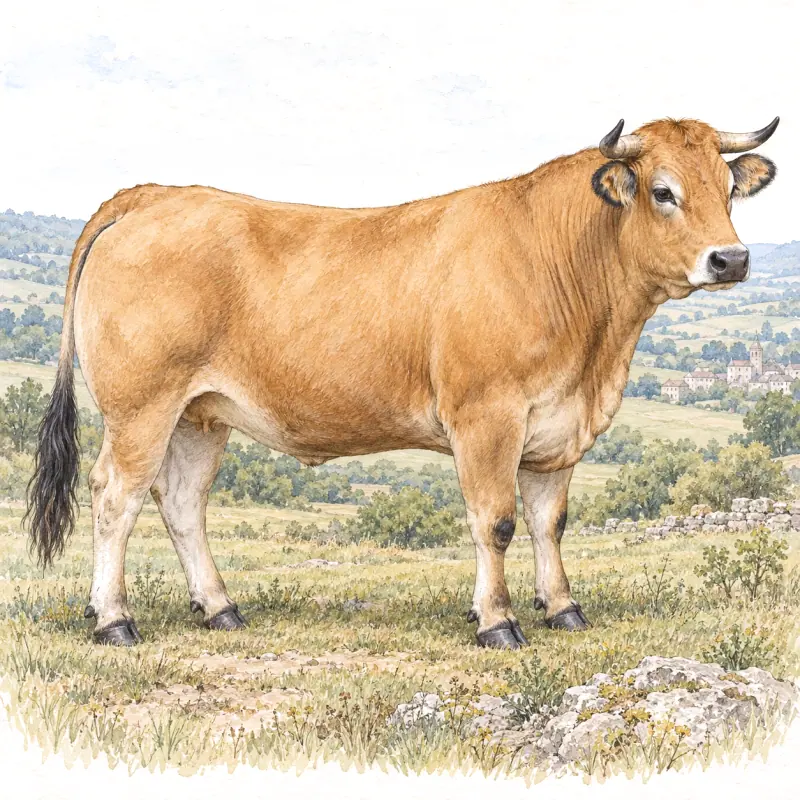
The coat is a solid fawn, light or dark wheaten and sometimes grey, paler around the muzzle and eyes. The muzzle, tail switch, ear edges and hooves are black. The horns are short and crescent-shaped. Males weigh 1,100 to 1,200 kg and females 700 to 1,000 kg. Interbev describes the meat as bright red, fine-fibred and tightly marbled, and prized for grilling cuts. The breed has its own Label Rouge.
How it connects
Breed
- related Normande