Meat · Breed · Short entry
Herdwick
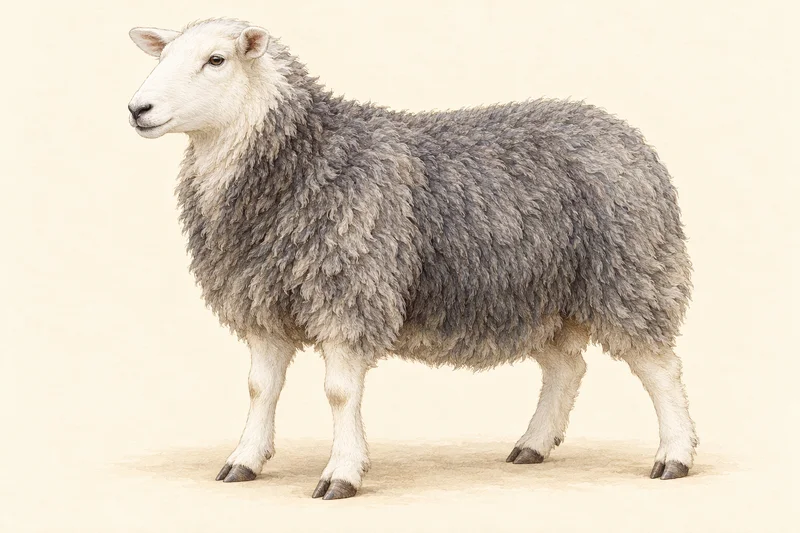
The native hill sheep of the central and western Lake District, widely held to be the hardiest British breed. Lambs are born almost black; adults have white heads and legs and a fleece from slate blue-grey to light grey. Meat from pure-bred Herdwicks born, raised and slaughtered in Cumbria is protected as Lakeland Herdwick (PDO).
Heafs, fells and Beatrix Potter
The Lakeland Herdwick PDO specification says the word Herdwick can be traced to the twelfth century, seemingly from Old Norse, and meant a sheep farm; by the eighteenth century it was attached to the breed itself. The earliest serious description is in Bailey and Culley's report for the Board of Agriculture on the agriculture of Cumberland in the 1790s. The heart of Herdwick country is the fells and valleys of Borrowdale, Buttermere, Ennerdale, Wasdale, Eskdale, the Duddon valley, Coniston, the Langdales and the Helvellyn area.
Much of this grazing is open common land. Ewes learn their farm's part of the fell, the "heaf", from their mothers, so farms keep a heafed "landlord's flock" that stays with the land. In the 1920s Beatrix Potter bought Lake District farms and encouraged the revival of the Herdwick; on her death in 1943 she left them to the National Trust, asking that the sheep be kept pure Herdwick. The specification counts around 50,000 Herdwicks on around 120 farms.
Lakeland Herdwick meat
Herdwick lambs are slaughtered at 8 to 12 months, much older than lowland lambs, at 28 to 40 kg live weight and 14 to 22 kg carcass weight. The specification describes the meat as fine-grained and tender, pink to dark pink, with firm white fat and a more intense, gamey flavour from the long grazing period. It cites a 1996–1997 study by J. D. Wood at the University of Bristol that rated its flavour and eating quality above standard cross-bred lamb.