
Meat · Breed · Short entry
Damascus
A large, reddish-brown, long-eared goat native to Syria and neighbouring countries of the Near East, kept for both milk and meat. It was taken to Cyprus about 70 years before 2006 to improve local goats and has been selected there for more than 40 years. It combines high prolificacy with high milk yield.
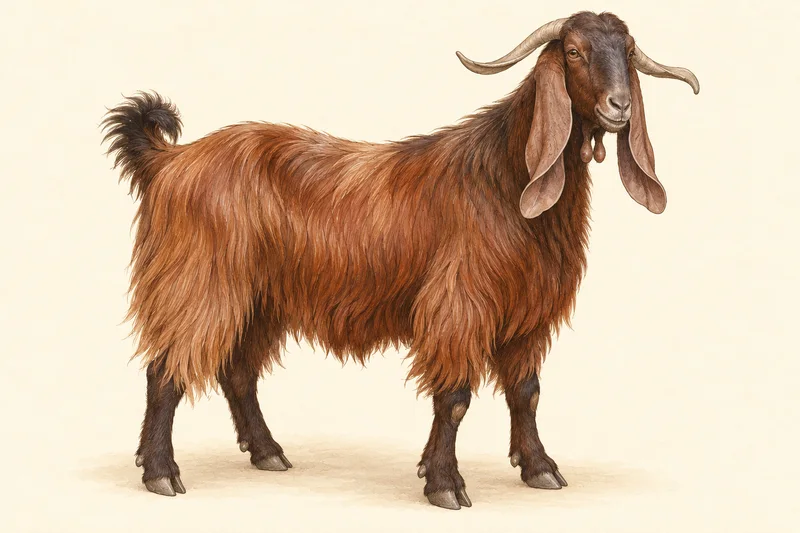
The Damascus goat in Cyprus
Mavrogenis, Antoniades and Hooper (2006) describe the Damascus as a native breed of Syria and other Near Eastern countries, imported into Cyprus some 70 years earlier to upgrade the local goat. It has since been selected for milk and meat. An FAO/UNEP technical consultation on animal genetic resources named it among the breeds that deserve high priority. In Cyprus it is kept semi-intensively or intensively, typically in herds of 200 to 300 goats.
It breeds seasonally, from late August to mid-December. Total milk yield, including milk taken by the kids, ranges from 350 to 650 kg per lactation, with 3.8 to 4.5 % fat and 4.0 to 4.8 % protein. The authors note that horns in either sex are associated with intersexuality in this breed.