
Meat · Breed · Short entry
Cinta Senese
A black pig from the hills around Siena, named for the continuous white belt (cinta) that circles its body at the shoulders. Pictures of a belted pig like it date from the fourteenth century. It almost became extinct after the Second World War and has been recovered since the late 1980s; its meat has been an EU PDO since March 2012.
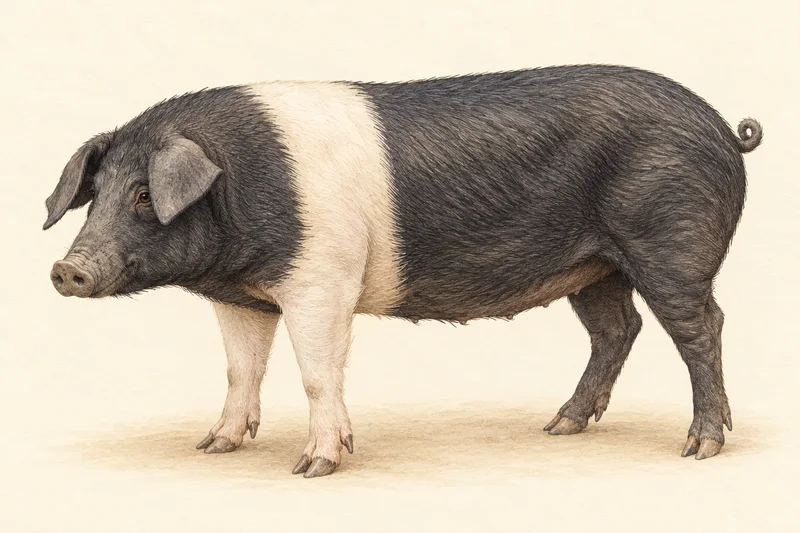
From the Montagnola to the DOP
The Italian pig breeders' association (ANAS) dates the breed's formation to the late Roman or early medieval period and cites fourteenth-century images of a belted pig similar to today's Cinta. There is general agreement that it originated in the Montagnola Senese and spread first through the Siena area, then to other parts of Tuscany and Italy. A herd book was opened at Siena in 1934.
After the Second World War, heavy use of English breeds, especially white breeds crossed to produce "grigi", brought a steep decline, and the herd book stopped working in the second half of the 1960s. The grey crosses had been fattened on dairy whey in the Po valley until 1968, when an African swine fever epidemic stopped pig movements out of Tuscany. Regional recovery work began in the late 1980s; a conservation section of the herd book opened in 1997, a breed register followed in 2001, and from March 2012 the meat of Cinta Senese pigs born and raised in Tuscany has been an EU PDO.